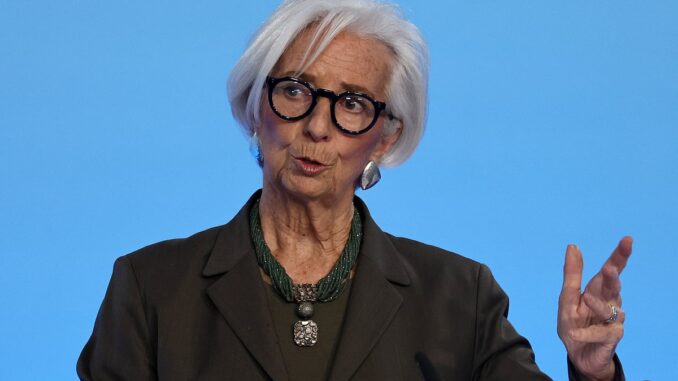
The president of the ECB, Christine Lagarde, this Sunday opposed a tax on capital that does not remain in Europe, defending instead the creation of incentives for private investments to remain in the European market.
“I’m more in favor of incentives than taxes. I think it works better”, he said in a debate at the 62nd session of the Munich Security Conference (MSC), in Germany, which began on Friday and ends this Sunday.
“If you look at the amount of money being invested right now by venture capital, especially in key sectors where price-to-earnings and price-to-book ratios are increasing considerably, the money is coming in,” pointed.
Lagarde stated that “innovation is indeed at a peak and venture capital funds are clearly realizing this.”
The president of the ECB highlighted, in this regard, that 37% of companies in Europe are adopting Artificial Intelligence (AI) and, in particular, generative AI in production processes, slightly more than companies in the United States.
The head of the euro zone monetary authority emphasized that the European internal market “is waking up”, because, although the growth of the Gross Domestic Product [PIB] of countries that share the single currency was 1.5% in 2025, “everything was consumption and investment”, while “exports had a negative impact”.
Likewise, she expressed hope that, in 2026, the Savings and Investment Union in the European Union (EU) would come to fruition, an initiative aimed at improving the channeling of savings into productive investments in the community bloc’s financial system.
“I’m not going to mention the famous Capital Markets Union, but I see that policymakers are starting to take it a little more seriously”, he considered, referring to a proposal launched in 2015 with the aim of deepening and integrating financial markets, but which has been stagnant for a decade.
There is a set of measures that are already “not something we are dreaming about or talking about for ten years, but which will arrive in 2026”, he said.
The ECB leader was referring to initiatives such as the revitalization of the securitization market in the EU, which banks have long been waiting for, greater supervision in the single market and savings and investment accounts for retailers in capital markets.
Leave a Reply