
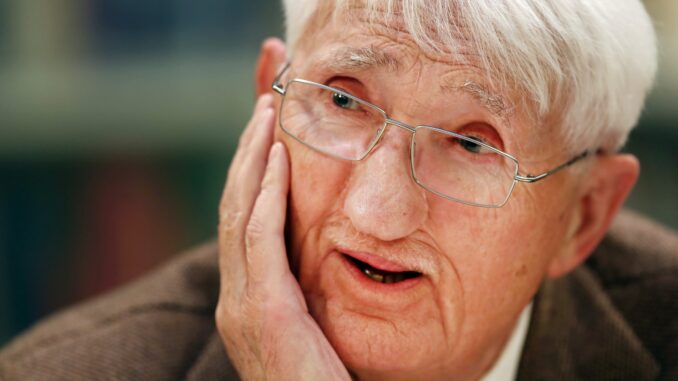
BERLIN (EFE).— The German philosopher Jürgen Habermasconsidered one of the most influential thinkers of the 20th and early 21st centuries, died this Saturday at 96 yearsas confirmed by its publisher in Germany, Suhrkamp.
“I can confirm that Jürgen Habermas has died today. This has been reported by his family. He died at home,” representatives of the publishing house told the EFE agency.
German media such as the magazine The mirror and the diary Bild They first reported on the philosopher’s death, citing the publisher as a source. Subsequently, German public television reported that the thinker died in Starnbergin the south of the country.
A key figure in contemporary philosophy
Habermas is especially remembered for his relationship with the city of Frankfurtwhere he developed much of his academic career as a philosopher and social theorist.
He was one of the central figures of the second generation of the Frankfurt Schoolan influential current of thought dedicated to the critical analysis of modern society. In the beginning he was an assistant to the philosopher Theodor W. Adornoone of the main representatives of that intellectual tradition.
Among his most influential works is “Theory of communicative action”published in 1981, in which he analyzed the role of dialogue, reason and communication in democratic life.
In addition to his work as a researcher, Habermas taught Philosophy classes at the Johann Wolfgang Goethe University Frankfurt.
International recognition
Throughout his career he received numerous awards, including the Prince of Asturias Award for Social Sciences in 2003for his contribution to contemporary thought and the analysis of democracy.
The Minister of Science of the state of Hesse, Timon Gremmelslamented his death and stated that Germany loses “one of the most prominent philosophers and social theorists of our time.”
“His thinking decisively marked the Critical Theory of the Frankfurt School and laid important foundations for the analysis of democracy, the public sphere and social reason,” he noted.
Influential intellectual in public debate
Habermas was also known for actively participating in political and social debates through articles and interviews in the media.
After learning of his death, several of Germany’s main newspapers highlighted his intellectual legacy.
The diary Frankfurter Allgemeine Zeitung He described it as “the man of an era“, while Frankfurter Rundschau He stressed that his work influenced generations of thinkers around the world.
The latter medium also highlighted that Habermas was a “global intellectual”known and studied both in Europe and in Latin America and Asia.
For its part, the newspaper South German newspaper lamented the death of whom he defined as “a great enlightener”also remembering his public interventions on contemporary political issues, such as Germany’s position towards Russia after the invasion of Ukraine.
With his death, one of the most influential voices in European philosophy in recent decades disappears, whose thought marked the study of democracy, communication and public debate in modern societies.
Leave a Reply