
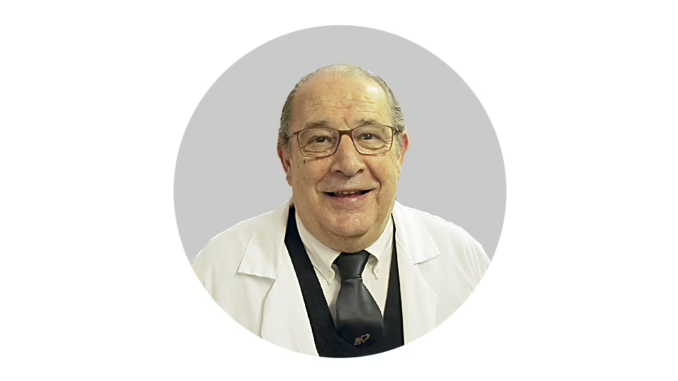
I already wrote here that the Ordinance 194 September 2014published in Republic Gazettesigned by Minister Paulo Macedo, which established the existence of Reference Centers, was the most important structural reform of the Health system since the creation of the SUS. And why? Because for the first time, with regard to the quality of medical services provided to patients, a clear position has been taken. The time when all hospitals, all ULS, in any part of the country, can offer their citizens quality medical care makes no sense. For serious or very complex diseases, not to mention rare ones, the possibility of setting up competent multidisciplinary teams, which can have access to case studies that guarantee experience and training capacity, is not compatible with the dispersion of supply.
Just like clinical governance, the multidisciplinary way of functioning is not compatible with individual decisions, outside the logic of strongly hierarchical teams, with strong leadership. Discuss or comment Health is not for everyone. It requires specific training, requires medical literacy, not to mention the advantage of in-depth knowledge of the field.
One of the proofs that our SUS is far from being chaos is because it is in it and only in it that, for certain serious, rare or very complex diseases, an effective response can be found. Therefore, the organization in Reference Centers, as long as it is practical, increases the quality supply of our Health system.
I have been sometimes (too many?) critical of the position of the Medical Association in relation to this structural reform of the SUS. A position that has excelled in silence, I would even say indifferent ostracism. Now, in this newspaper just ten days ago, the President of the Order of Doctors (OM), published an opinion article, with the title “The structural pillar of the SNS”, which ended this silence. With this position, which I endorse and welcome, he provided a fantastic service to all Portuguese patients. Having explicit, I would say total, support for this structural reform of our healthcare system is fundamental. Finally having OM and the government (this or any other) in tune with the implementation of Reference Centers is a big step forward. A giant step forward in demanding quality.
Congratulations Carlos Cortes. For the National Commission of Reference Centers, the public and explicit support of OM, as well as the support of the Ministry of Health, (with the urgent review of the ordinance) are the guarantee that we move forward in providing care to our patients.
PS – I have long defended an objective measure, which could significantly help the lack of specialist doctors in the SUS. This measure is simple, and I have never seen it discussed by the parties that represent us in the Legislative Assembly. But before mentioning it again I will give an example of what happened to me.
At the age of 30, in a public competition in which 84 surgeons competed for 12 specialist vacancies at the then Lisbon Civil Hospitals (HCL), I came in 2nd place and became a General Surgery specialist on the HCL staff. Was I capable of becoming autonomous, of performing complex surgeries, of not needing to be supervised? No, it wasn’t. Although I was already an expert, I still needed to continue learning from the more experienced and obeying my masters.
It was decisive for my progression to continue in the NHS and the NHS benefited from my workforce. I was not forced to continue, I did so because if I had given up I would never have reached levels of competence that would allow me to treat more serious and difficult illnesses.
Young specialists benefit from continuing a few more years in supervised work regimes to differentiate themselves. And here we have reached such a point that I want to talk to you, the obligation for young specialists, of any specialty necessarily acquired in the SUS, to have to stay at least two more years in the SUS, before being able to have other options, such as going to the private sector or immigrating. We owe this to the Portuguese who, with their taxes, paid for our education and who, afterwards, deserve civic and ethical return from us.
This measure is beneficial for increasing the competence of new specialists and is at the same time useful for the SUS, which can continue to count on these much-needed human resources.
I became a specialist without ever having performed complex surgery on the liver, bile ducts, or pancreas. And if I had left the NHS immediately after becoming a specialist, I would never have had an organ transplant.
Do you now understand why it is essential to stay a few more years in the SUS to be competent? What are we waiting for, in collaboration with the Medical Association, for the legislation to be changed? What are political parties waiting to say?
Portuguese patients cannot continue to believe that, to treat serious, rare or complex illnesses, any specialist doctor will do, just as any hospital will do. Only long after I became a specialist and continued to be tutored by my masters, I was able to acquire skills that I would never have achieved if I had abandoned the SNS. Our patients deserve respect, they deserve to be guaranteed the highest possible quality of treatment for their illnesses.
Forcing young specialists to stay at least two more years in the SUS services that trained them is a “two in one”. Fundamental to guarantee medical quality in the future and absolutely decisive to guarantee human resources in the SUS. Was I clear?
Write with the old spelling
Leave a Reply