
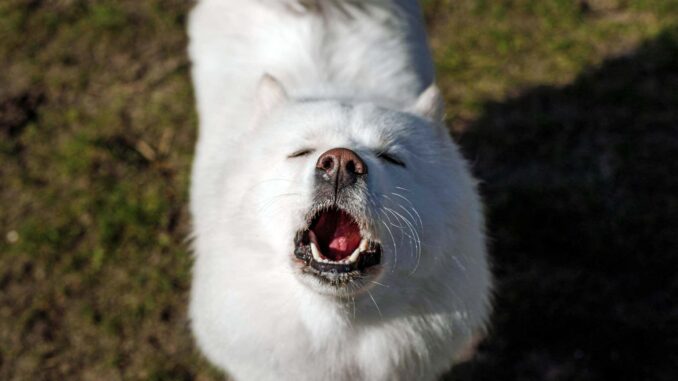
Some Samoyed dogs howl to music
Photo by Adri / Alamy
Scroll through #SingingDog hashtags on social media and you’ll find many clips of dogs howling to their favorite tunes. But can a dog Callas show some real musicality?
That’s the psychologist’s question Anirudh Patel at Tufts University in Massachusetts and his colleagues tried to answer with a new, intriguing study that shows that some canine divas actually perceive pitch and adjust their vocalizations accordingly.
The researchers were inspired descriptions of howling wolves in a pack. “Howls have some similarities to human singing in that they are long, sustained chants,” says Patel. Observations from the wild suggest that each individual wolf tries to strike a different note. The result is a discordant chorus that could create the illusion of a much larger group, which would help deter potential predators. “That’s why some wolf biologists thought they were actually paying attention and changing their pitch,” he says.
Of course, this is very difficult to test experimentally, which is why Patel and his colleagues turned to pets. They asked a handful of dog owners to record their dog’s harmonies to their personally preferred track—first in their original key and then in versions that were transposed three semitones higher and three semitones lower—to see how they would respond to the change in pitch.
The researchers focused their analysis on two ancient breeds – the Samoyed and the Shiba Inus – which are thought to be more closely related to their wolf ancestors than the modern varieties. To increase the statistical reliability of the analysis, each dog had to produce at least 30 howls, each lasting at least 1 second, for each of the transposed versions.
All four Samoyeds studied showed some sensitivity to the pitch of the piece, consistently adapting their vocalizations to the new key, although by no means exactly matching it.
“They’re trying to relate to what they’re hearing in their own voice; they’re not just being triggered to release some instinctive, inflexible response,” says Patel. Luna, one of the contestants, performs Lady Gaga and Bradley Cooper’s “Shallow” here:
In contrast, the two shiba inus looked deaf. “It’s possible there’s some genetic variation among ancient breeds that makes some more prone to howling,” Patel posits — though he admits he might have found more musicality in a larger sample.
The findings could offer some insight into the origins of human music. Some theorists have argued that singing evolved from the fine motor control that comes with speech, allowing us to imitate complex sounds, but the fact that dogs can also control pitch without any other forms of vocal learning suggests that language would not be a necessary precursor. “It’s possible that our ability and desire to coordinate pitch with others when we sing has very ancient evolutionary roots and may not just be a byproduct of our ability to imitate complex sounds,” says Patel.
Another question is why dogs feel the need to connect. “From the videos we’ve watched, the dogs seem really into the music,” he says. They weren’t just looking at their owner for the reward, but were staring intently into the distance. “I think so [the music] it’s kind of a howl-like surrogate signal for them and it gets them into this social mode where they want to join in.”
Buddhamas Pralle Kriengwatana at KU Leuven in Belgium, who recently co-authored a review article by the researcher evidence for music appreciation in nonhuman animalsshe is intrigued by the findings, although she would like to see more diverse samples. “It would be nice if they had a comparison of ancient and modern breeds,” he says.
As for the dogs’ somewhat discordant efforts, he suggests that there may be many reasons why they don’t match the exact pitch of the sounds. “Who knows, maybe they want their voices to be heard and to be heard singing,” she says.
topics:
Leave a Reply