
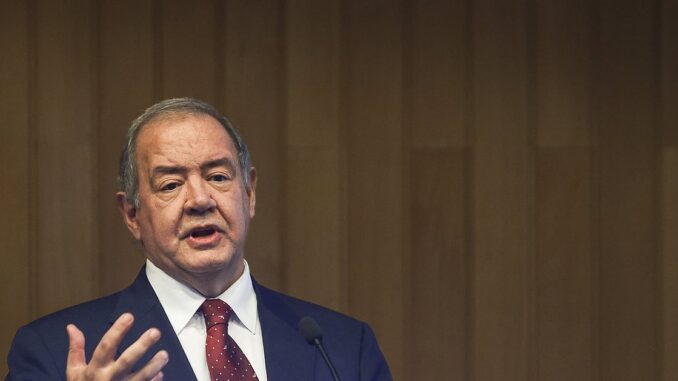
“Either this is contained quickly and therefore will not have major effects in the future, (or) it will be a one-off episode if the conflict ends quickly (…), but be careful – at this point – there is no sign that the conflict will end quickly”highlights Antônio Costa Silva.
If it finishes quickly, “We may have this turbulence in the market here, some effect on inflation, because inflation is also growing”, since the price of energy “has a significant impact”.
“We may have temporary inflation that will grow”, but without consequences in terms of interest rates and policy, either from the European Central Bank (ECB) or the United States Federal Reserve (Fed), he says.
Therefore, similar to the scenario that occurred with the US attack on Iran in June last year, “in which oil and gas prices rose”, but as it was a 12-day conflict “the effect was temporary” and the economy recovered.
In short, “a sneeze, but no prolonged cold” in this scenario.
However, President Trump says the conflict “will last four to five weeks and has the capacity to continue longer.”
“I think this American Administration is totally irresponsible, because this conflict is very reminiscent of what happened in Iraq in 2003″, with “very big” similarities, he continues.
Trump attacks Iran based on “wrong assumptions”, that it had ballistic missiles and were going to hit the USA, which “is not true, it is a fallacy” and six months ago it said that it had obliterated “Iran’s nuclear capacity”, he emphasizes.
“There is total inconsistency and it is completely erratic. This does not mean that the Iranian regime is not an execrable regime, because it murdered thousands and thousands of citizens just a few weeks ago, it is an authoritarian and extremely repressive theocracy”, he criticizes.
Now, “as proved in Iraq, regimes don’t change, there is no regime change from abroad and, above all, with an invasion”, recalls António Costa Silva, lamenting that Israel is “conditioning US foreign policy”, which he calls “disturbing” with “very serious” consequences, destabilizing the entire Middle East.
The Iranian regime is desperate” and “shoots everywherewhich leads to a second “more worrying” scenario, which is the persistence of high prices in the market. Oil has surpassed the 85 dollar barrier, the highest weekly increase in two years, and the price of gas is also very high, he recalls.
“If the conflict persists, prices will continue to soar” and “we will most likely have a major inflationary outbreak and the European Central Bank and the United States Federal Reserve will be forced to intervene”, admits, what if it happens, “it will be very difficult for the economies.
Markets are already anticipating “a 25 basis point increase in the interest rate, there is a 50% chance” this year, in a reversal of the existing trend.
“If interest rates really increase, it is a serious risk because it will widen the spread of sovereign bonds in euro countries and, therefore, we will return to that previous situation”, he warns.
Currently, the most significant impacts are the shutdown of critical infrastructure throughout the greater Middle East region, he highlights.
65% of the world’s oil and gas reserves are concentrated in the Arabian Peninsula, plus Iran and Iraq.
“At this point, two of the most critical infrastructures are paralyzed: one has to do with Saudi Arabia, which is the port of Ras Tanura, which is connected to the largest petrochemical complex in the world, which is the Abequeia (Abqaiq) complex, where eight million barrels per day are processed” and has next door the largest oil field in the world, Ghawar.
This “is very significant because it is the heart of the international petroleum system” and then Qatar, which has the largest gas field in the world, which is Northfield, which continues to Iran’s side, crucial for gas markets and exports through the port of Raj Laffan, is also paralyzed.
“I just wanted to remind you that the 20 million barrels of oil that pass through the Strait of Hormuz mean” a lot to Asian countries: more than 84% of this oil that passes goes to Asian countries.
In other words, it represents 86% of oil imports for Japan, 84% for South Korea, 42% for China and 22% for the European Union (EU).
The EU, following the war in Ukraine, managed to diversify its dependence on Russian gas and now imports it from the USA.
Afterwards, “the other part of European gas is imported from Qatar, which is exactly the structure that is paralyzed”, he says.
The United States and Israel launched a military attack against Iran on February 28, killing Ayatollah Ali Khamenei, the country’s supreme leader since 1989, during the offensive.
Leave a Reply