
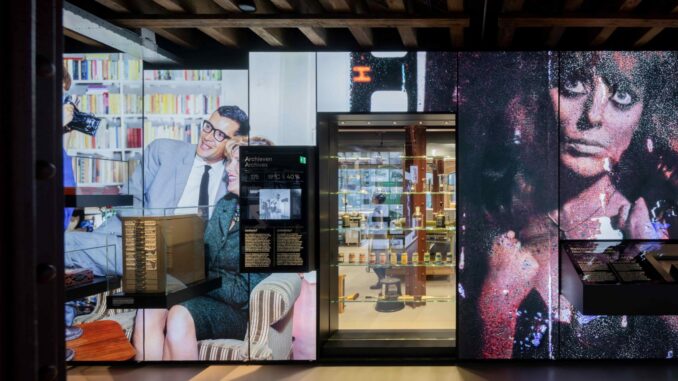
The opening of the new headquarters of the Nederlands Fotomuseum (or Museo de Fotografía de los Países Bajos) includes a step forward in consolidating Rotterdam as a powerful cultural enclave in Europe. The museum offer is moving from the center to the Rijnhaven area and the Katendrecht district, where this newly opened photography museum is located in the imaginative architecture and port hangars, as well as the Fenix or migration museum and soon the Danshuis, which is dedicated here exclusively to dance.
El Nederlands Fotomuseum if located in the Santos Industrial Building, Opened in 1902 as a cafe originating from the Brazilian city of the same name. Considered one of the best-preserved buildings in the country, the renovation was carried out by the Renner Hainke Wirth Zirn (Hamburg) and Wdjarchitecten (Rotterdam) studios.
The exterior and interior remain practically in their original condition. On top of the five plants, two more rows of plants are crowned with the iconic “crown” that joins the old and the new. Of the five steps, the first is intended for both permanent collection and temporary exposure, and the other two are storage areas and storage volumes.
The location of the library – one of the most important above the photo book – accessible on the lower floor is today a declaration of intent. More than its shape, the building focuses on specific technical aspects, climate control and lighting to preserve even the smallest negatives.
Fundado has its signature, the photography museum has the same mission of heritage, investigation and dissemination, presentation, restoration and conservation of Dutch photography. It is established as a reference point for photography lovers regardless of the process. With approximately 6.5 million items including negatives and slides, contact sheets, positive copies, albums, cameras, etc., it is one of the most important collections in the world.
Interior of the building. Photo: Studiohanswilschut
Here comes documentary photography, photojournalism and art photography: from the first daguerreotype produced in 1842 to digital works and art installations; From the first photographs taken in ultramarine territories to the care of 175 photographic archives that include renowned photographers such as Ed van der Elsken, Cas Oorthuys and Esther Kroon. The national character of the museum is conceived as a whole and can be contained in its deposits: the archive and the social, political, economic and cultural history of the entire state, formerly a colonial power.
As stated, of the four museum employees half of the work in the collection department. In addition to hiding the conservation and restoration work, these spaces remain partially visible to the viewer through the glass on the second and third floors. The hidden diseases of the photochemical medium and deterioration are shown to the public in a didactic form.
The fragility of the “technical image”, based on the expression of photography theorist Vilém Flusser, is compensated by its extreme versatility and ways of working. It is for this reason that one of the primary goals of the museum is to disseminate the social and scientific history of photography.
The humidity conditions here are very strict and the public understands that the temperature to maintain a negative and transparent temperature is 4º Celsius.while the photographic paper must be kept at 12º. Yes, for example, there is a media emergency and if you have to digitize a negative stored at 4º in your drawer, it cannot be suddenly transferred to a natural environment of 20º, which requires at least two intermediate steps of vein acclimatization every hour. That is why tens of negatives are digitized every day and a lot of work is done.
Fachada of the building: Photo: Studio Hans Wilschut
The museum opens to the public with three exhibits: on the first floor is the “hall of honor of Dutch photography”, where some of the joys of the collection are exhibited by artists or photographers such as Piet Zwart, Paul Huf, Bas Jan Ader, Rineke Dijkstra, Anton Corbijn or Erwin Olaf. In fourth place, we commissioned an exhibition about Rotterdam and its urban landscape transformations across the street with more than three scientific images.
With Flawless View is an example of multiple ways to view a photo from the current view. Finally, it represents the fifth plan Waking up in bluean exhibition where dozens of artists reinterpret and experiment with the cyanotype technique, or a monochrome photographic process that creates a negative copy in Prussian blue.
With impeccable editing, it is an example of how to view a photo from a contemporary perspective.
The combination of this new museum is very attractivehoping for a program that presents the most current curatorial discourses such as decoloniality. Not only Dutch photography is now an absolute point of reference for the world community.
Leave a Reply