
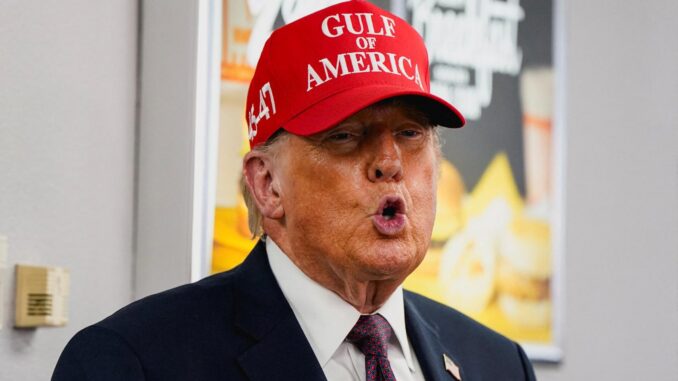
“We said ‘no’ to more foreign wars and ‘no’ to more regime changes one rally after another,” commented the former congresswoman. Marjorie Taylor Greeneconsidered one of the main figures of the radical populist right in Washington. “But it’s all a lie and the interests of the United States always come last.”
While Taylor Greene’s rebuke was to be expected – she resigned from her seat two months ago after distancing herself from Donald Trump–, there are those who expected a little more waist from Carlson given his closeness to the American president.
In fact, his last visit to the White House took place last week. But his animosity towards US interventions abroad, against which he has railed several times in the past, has prevailed and hence the comment.
Carlson, by the way, spoke in those terms during a conversation with the chief correspondent of ABC News en Washington: Jonathan Carl. Karl explained that he sought Carlson’s opinion because, despite being “just a person,” he is also “a prominent figure within Trumpism.”
“This is a momentous and potentially decisive, or perhaps redefining, step for Trump,” Karl added. “He entered politics promising to end what he called eternal wars, he criticized the Iraq war, stated that he had always opposed it, and now he finds himself initiating what could be a major conflict with Iran.”
The decision to launch a massive attack against Iran together with Israel appears to have been made in the early hours of Saturday and, beyond the aforementioned criticism, it has also generated controversy within the United States Congress itself.
Several members of the Democratic Party and at least two members of the Republican Party have reacted to what Trump has described as “major combat operations” by demanding that Congress vote before the country enters a new conflict.
“This is not America First“he declared on his social networks Thomas MassieRepublican Party congressman from Kentucky. He also stated that in the next session of Congress he will work with the congresswoman Ro Khannaof the California Democratic Party, to try to force a vote in the chambers on the war with Iran.
A historical gap
This debate reflects a persistent gap between the American constitutional design – which reserves the power to declare war to the legislative branch – and the practice of deploying forces by the president in office without prior authorization.
In 1973, after the Vietnam War, Congress passed the so-called War Powers Resolution in order to limit this practice.
This resolution established that the president can only act unilaterally in the event of an attack. In other words: in self-defense. And if you are forced to carry out an urgent deployment, the measure establishes a grace period of 60 days. That is to say: if after two months Congress has not granted its authorization, the deployed troops must return.
However, these limits have frequently been exceeded. So much Barack Obama –in Libya– and Trump –during his recent military operation against drug trafficking– have maintained that certain air campaigns are not subject to the rule.
Other presidents have sought formal authorization to start major land wars, such as Afghanistan or Iraq, but they have also unilaterally extended the established deadlines and have claimed the power to undertake limited interventions in the national interest without legislative approval.
In relation to the latter, Trump himself, without going any further, has ordered actions such as the assassination of the Iranian general Qassem Soleimanithe bombings against Iran months ago and the invasion of Venezuela to stop Nicolas Maduro.
It is true that none of those military operations caused American casualties. And that is, in practice, the main political brake: when Congress authorizes a war, it is the country that collectively assumes the human cost, not just the president who orders it.
But if this Saturday’s attack on Iran leads to a prolonged war, it is likely that American casualties will begin to follow.
Leave a Reply