
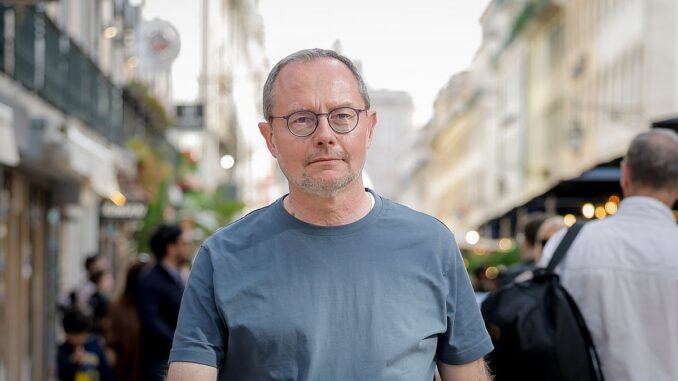
Xavier Debrun is Belgian, but was hired in the global market by the Bank of France as chief economist, a position he assumed on February 2nd. He graduated in economics from the universities of Namur and Harvard, and has been chief economist at the National Bank of Belgium since 2019. Previously, he lived in the United States for 20 years, where he worked in the budgetary affairs department of the International Monetary Fund. We met in Lisbon, this week, on one of the first calm days after almost a month of storms in Portugal.
This is the second of two parts of the interview he gave to DN and Dinheiro Vivo.
What should governments and companies do to improve productivity?
There are several reforms to consider. The reports by Mario Draghi and Enrico Letta outline the path for reform in Europe. An important pillar is the completion of the single market. We have a single market, but there are still many barriers. I refer to the single market for goods and services. Today, many obstacles remain, as documented in numerous studies. Some are related to language, for example. If I want to buy a certain service and I speak French and you speak Portuguese, it may be difficult for me to buy that service in Portugal. Imagine that I want to buy insurance in Portugal, but the contract is in Portuguese — this is complicated. It can be said that translation could solve the problem, but language remains a barrier. Country-specific regulations also persist. These make it difficult to say, “This service or good is cheaper in Denmark; I will go to Denmark.” Taxation is another area where harmonization is desirable, although inevitably difficult. A third issue concerns investment and Europe’s ability to mobilize European savings, which are high. We have a lot of resources, but they often don’t reach European projects.
Is regulation a problem?
Let me give you an example. In addition to country-specific tax systems, we do not have the same bankruptcy laws, consumer protection laws, or investor protection laws. Therefore, if you are a Portuguese company looking to finance a profitable project and want to access money from German savers, it is complicated because you need to go to Germany, check what German legislation requires and determine what information you need to provide to issue your shares on the German stock exchange. So, things remain very fragmented.
We have been discussing these issues for decades.
Yes, indeed.
Are reforms really difficult to make or are policymakers procrastinating?
They are difficult to implement. You’ve probably heard of the famous “28th regime”. The idea is that, instead of harmonizing 27 different national regimes — for bankruptcy, taxes, consumer protection, investor protection and so on — we create a 28th regime that is attractive enough to ensure that everyone wants to use and consult it. So, hopefully, we could eliminate many barriers and build a true capital markets union. It could be done. The question is: how do we define the various elements of this 28th regime in a way that is acceptable to all 27 countries?
How can we motivate millions of people in 27 countries to adopt it?
Let’s go back to the time of the creation of the euro. At that moment, the Europeans said: “OK, on January 1, 1999, the euro will be created. Whether you are ready or not, that is your choice.” And many countries managed to join the euro because they knew what conditions needed to be met and fulfilled them. Having a deadline, setting an end or start date, such as: “On January 1, 2028, we will have a 28th regime” — this embodies a commitment. You commit to something and say, “This is in our interest; we should do it.” With a date, people mobilize more and commit more to the objective. I see great value in ambitious, time-bound commitments. Today, perhaps we are being a little too reactive: a crisis happens and then we hastily look for temporary solutions.
Are we living in the moment? The times are very chaotic and aggressive.
The political environment is obviously difficult and being a decision-maker is not easy these days. There is something known among economists as the “Juncker Curse”. Jean-Claude Juncker, former president of the European Commission, said something like: “We politicians know what to do, but when we do it, we are not re-elected”. That, essentially, is the problem. I don’t know to what extent this “curse” actually exists, but we must avoid getting into a situation where people start to think that leaders don’t really know what to do.
Juncker was in a more difficult position during the eurozone financial crisis. I didn’t have the right tools to support countries like Portugal, Greece, Ireland, Spain…
Exactly. And now at least we have more tools. We talk a lot about crisis risk and so on. There is always a risk of crisis, always. But one positive development since 2008 is that Europe is now much better equipped to face a crisis than before. And countries that faced vulnerabilities then — including Portugal, Greece and Spain — are much stronger today. If we look at the situation of public finances in Portugal, it is the envy of many countries.
There are those who say that we, in Portugal, now have some room for maneuver to face a new crisis.
Yes, exactly. It is the envy of many countries because it has regained room for maneuver in case of need. At the same time, the consequences of the 2008 crisis were incredibly painful. However, they allowed the implementation of essential reforms, paving the way for solid public finances and the improvement of economic conditions that we observe today in Portugal and other countries.
Leave a Reply