
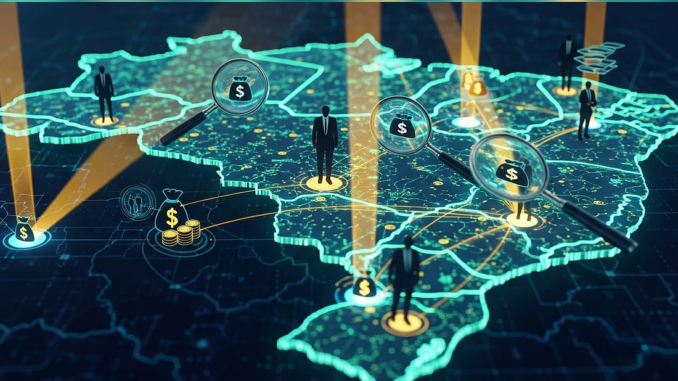
Brazilian programmer Bruno César developed a tool that aims to transform the way civil society can monitor the use of public money. With the project “Brazilian Accelerationism” (br/acc), he created an Artificial Intelligence ecosystem capable of crossing an immensity of data from official databases — such as the Central Bank, IBGE and the Superior Electoral Court (TSE) — to identify signs of corruption which, until now, remained hidden under dense layers of bureaucracy and IT fragmentation.
The tool is not limited to a simple search for names or values. It operates on a computer infrastructure capable of processing around 1 terabyte of structured data performing complex crossings entirely “in-memory”, guaranteeing an analysis speed that would be impossible in traditional storage systems.
The “brain” of the system combines state-of-the-art language models to solve one of the biggest problems in public transparency: data disorganization.
Codex (from OpenAI) was used to plan and write the complexes scripts standardizationtransforming disjointed PDF files and CSV tables into a readable format. PSubsequently, Claude Opus 4.6 helped in the execution and refinement of the analysis logicfunctioning as a digital auditor that identifies semantic and operational inconsistencies in massive volumes of information.
However, the The real difference lies in the Neo4j graph database: Unlike traditional Excel or SQL tables where data is trapped in rigid columns, This system allows us to view the State as a living network of relationships. When entering the CPF of a public agent, for example, the system not only shows their salary, it instantly maps “nodes” and “edges” that connect family members, equity interests in companies and contracts signed with the public sector. This approach exposes “cross-nepotism” and conflicts of interest that, because they are indirect, would be almost impossible to detect through conventional research methods.
Results: a pattern that goes beyond parties and legislatures
As reported this week, the tool’s first conclusions are revealing: the patterns of irregularities in public expenditure, such as ghost employees with ties to multiple city halls, the self-direction of parliamentary amendments to newly created companies and shell companies that win bids on the eve of their foundation, do not appear as isolated events of a specific administration. Quite the contrary.
Graph analysis demonstrates that these “red flags” are systemic. Networks of influence and suppliers who benefit from suspicious contracts often remain active for decades, cutting across different governments and ideological hues with impressive resilience. The system thus empirically demonstrates that corruption in the State is not just the result of “bad people” who occupy power, but rather the consequence, one might say inevitable, of a system of perverse incentives — when the bureaucracy is opaque and decision-making power is centralized, the structure attracts and allows predatory behavior, regardless of who holds the presidential pen or the party that occupies the seats in Congress.
You need to leave your personal computer
The tool currently runs only on hardware Bruno César’s personal team, but the objective is ambitious and focused on social scalability. The developer plans to open a beta phase for investigative journalists, civil society organizations and supervisory bodies, groups that can validate the hypotheses raised by AI in the field.
More than that, César considers making the project open sourcewhich will allow any citizen to participate in State inspection actions.
Leave a Reply