
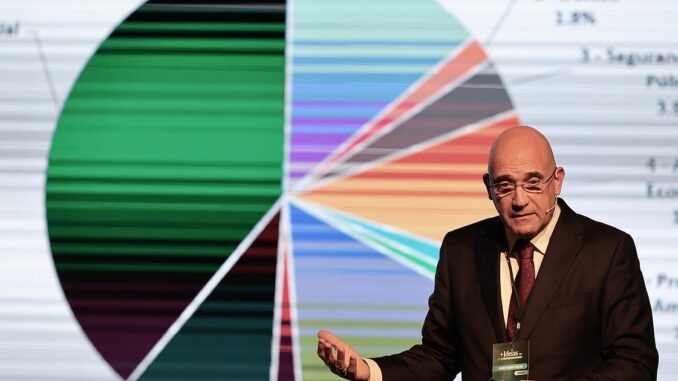
Pedro Passos Coelho once again described the possibility of returning to active politics as “unlikely”, because “if everything goes well why will they look for it in the chest of History” who stopped being prime minister more than a decade ago, and left the leadership of the PSD eight years ago.
“I don’t know if I’ll ever be precise again and I’m not even going to waste time speculating about it,” he said.ensuring that he does not even know when there will be direct elections for the leadership of his party, when answering questions from some of the hundreds of people who heard him speak about “Reform to Grow”, at the highlight of the Mais Ideias conferencewith which Instituto Mais Liberdade marked its fifth anniversary this Saturday, at Fundação Oriente, in Lisbon. In the audience were MEP and former presidential candidate João Cotrim de Figueiredo and deputy Carlos Guimarães Pinto, founder of the organizing entity, both former presidents of the Liberal Initiative, but also former socialist minister João Galambaas well as activists from several center-right parties, including Chega.
Passos Coelho, who at the end of the session told journalists he agreed when Luís Montenegro argued that one should not “feed the soap opera” that his public interventions were a sign of a desire to return to active politics, once again presented ideas to ensure greater economic growth in Portugal. And he avoided repeating references that irritated senior PSD figures, such as when he argued that the appointment of Luís Neves, who was national director of the Judiciary Police, as Minister of Internal Administration set “a serious precedent”.
Criticizing the “constitutional barrier” that prevents true reform in Public Administration, so “we continue to place personnel where they are not needed”, Passos Coelho admitted that “he is not seeing a broad consensus in Portuguese society” for the revision of the Constitution that he believes is necessary.
He also mentioned that, with regard to Social Security, “we have been telling an old wives’ tale for years”, as the system will have more charges than revenues in the 1930s and part of the 1940s.due to the demographic crisis. “We lost ten years”, he said, remembering that he proposed to António Costa, in a debate for the 2015 legislative elections, that they both commit to a reform in financing. But he ended up leaving a barb for the AD Executive: “I don’t know what the current Government says about this.”
The former prime minister was more direct when he said he was impressed that “the talk of State Reform began with the creation of the Ministry of State Reform”considering that “from a symbolic point of view” Luís Montenegro’s decision was not effective. Despite praising the holder of the portfolio, Gonçalo Saraiva Matias, Passos Coelho countered that it would be better to concentrate this mission on the Presidency of the Council of Ministers and recalled that, like his predecessor José Sócrates, he carried out many mergers of bodies that “were of no use”. “Today I would do everything differently. We wasted a lot of time discussing organic laws that brought very little”, said the university professor who governed Portugal between 2011 and 2015.
Focusing on the need to increase the efficiency of the State and respond to productivity challenges in a world changed by Artificial Intelligence, Passos Coelho criticized an education system in which students “leave universities with qualifications, but with worse performance, year after year”warning that “we have been infantilizing students for too many years”, and for the “budgetary lie” that falls on a National Health Service in which “there was no increase in demand and inflation to justify the increase in annual current expenditure”. “The other half of this growth went into someone’s pocket,” he said.regretting that the socialist government that succeeded it retreated from the model of public-private partnerships in hospital management.
He also said that “the State is today a very strong brake on growth”, due to regulation that does not workalthough he highlighted that “deregulation leads to monopolies”, and that Portugal “may have been more efficient” with “some capital restrictions”. For the former prime minister, European funds created the idea that there is no opportunity cost, constituting “a very large incentive for inefficiency”so “we are throwing money on the street a bit”. And he compared this capital inflow unfavorably with remittances from emigrants, which represented around 10% of GDP until the 1980s”, with the assumption of ensuring results.
Leave a Reply