
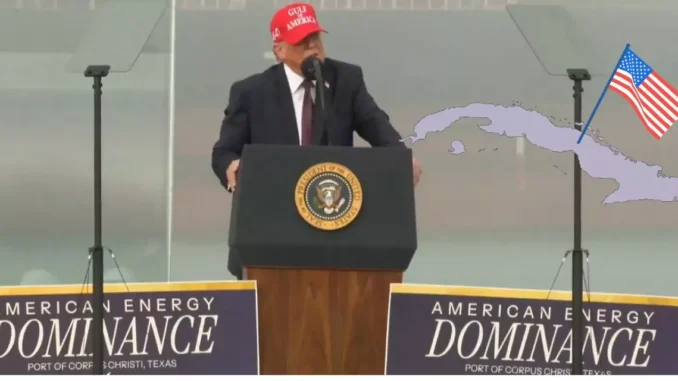
In an unexpected turn for United States foreign policy, President Donald Trump confirmed that his administration maintains direct negotiations with the Cuban regime. According to statements by the president before leaving the White House, the economic fragility of the island could lead to what he described as a “friendly and controlled takeover.”
“The Cuban government is talking to us. They are in big trouble, they have no money, they have nothing… Maybe we will have a friendly takeover of Cuba,” Trump told reporters, underlining the crisis Havana is going through.
NEGOTIATIONS UNDER THE LUPES: THE ROLE OF MARCO RUBIO
As Trump’s rhetoric escalates, it has been revealed that Secretary of State Marco Rubio’s team held key meetings with Raúl Castro’s grandson during the recent Caricom summit.
Key points of these discussions include:
- Sanctions relief: A gradual reduction in US economic restrictions is being discussed in exchange for structural reforms on the island.
- Monthly evaluation: The changes implemented by Cuban leaders would be monitored on a “month by month” period to decide the continuity of the relief.
- Energy dependence: The administration announced plans for U.S. companies to send fuel to private Cuban companies, seeking to strengthen the private sector and weaken state control.
DIPLOMATIC TENSION AFTER MARITIME INCIDENT
These statements occur in a context of maximum sensitivity, after a fatal incident with a boat this week.
Although Cuba described those involved as “terrorists” trained on US soil, the Vice Minister of Foreign Affairs, Carlos Fernández de Cossio, highlighted Washington’s unusual willingness to clarify the facts. For his part, Marco Rubio assured that the United States will carry out an exhaustive investigation before taking additional measures.
A CHANGE IN STRATEGY: INTERVENTION OR NEGOTIATION?
The mention of a “friendly takeover” by Trump comes at a time of reinforced economic blockade and after the breakdown of relations with Cuba’s key ally, Nicolás Maduro in Venezuela.
For Havana, this rhetoric evokes historical episodes of confrontation, such as the Bay of Pigs invasion or the activities of figures classified as terrorists by the FBI, such as Luis Posada Carriles. However, the openness to negotiating a possible relief of sanctions marks a different nuance in the current Republican administration.
Leave a Reply