
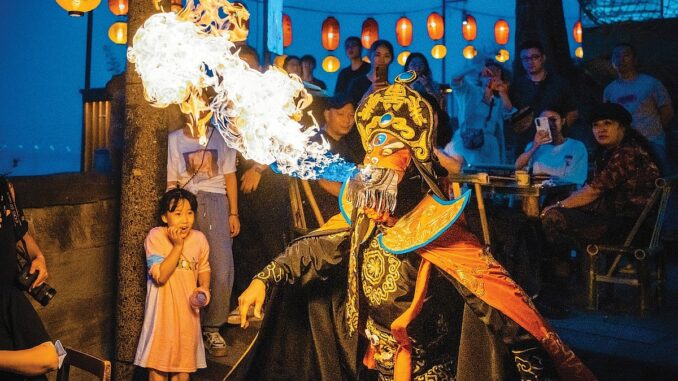
In 2006, it was inscribed on the National List of Intangible Cultural Heritage of China. Sichuan Opera is characterized by numerous specialized skills, with face-changing (bian lian in Chinese) – the extraordinary technique of altering facial appearance in an instant – constituting the central art and most distinctive feature of Sichuan Opera. With exceptional dexterity, the artists change masks in the blink of an eye, immediately making the characters’ inner world visible to the audience.
Unlike other forms of opera such as Peking Opera or Cantonese Opera, which emphasize singing and body movements, Sichuan Opera emphasizes exaggerated visual expression. The artists can change more than ten masks in just 20 seconds, vividly conveying the changes in the characters’ emotional states.
Changing your face is mainly based on three fundamental techniques: “scrubbing the face” (mo lian) consists of leaving a portion of facial paint on a specific part of the face and spreading it with your hands to transform the appearance; “blowing the face” (chui lian) takes advantage of the dance movements in which the artist bends down to blow colored powder from a box, resulting in an instantaneous change in the face; the most complex is “pulling the face” (che lian), in which masks painted on satin fabric are applied sequentially to the face, being removed one by one under the guise of dance movements, creating an effect of multiple transformations.
The artist’s instantaneous change of masks reflects the character’s variable emotions – joy, anger, sadness and happiness -, incorporating the Chinese cultural concept that the heart shapes appearance and transforms with internal dispositions, constituting a romantically inspired technique to reveal the characters’ thoughts and feelings. Even if the audience is unfamiliar with the plot, they can quickly understand the characters’ personalities and emotional fluctuations.
Each color and pattern of Sichuan Opera masks has a specific meaning: red represents courage and justice, black symbolizes altruism and determination, yellow and white generally denote deceit and cunning, among others.
Accompanied by the momentum of gongs and drums, and with agile dance steps, the artists precisely synchronize each mask change to the musical rhythm, giving the theatrical presentation an unexpected and absolutely magnificent effect.
Leave a Reply