
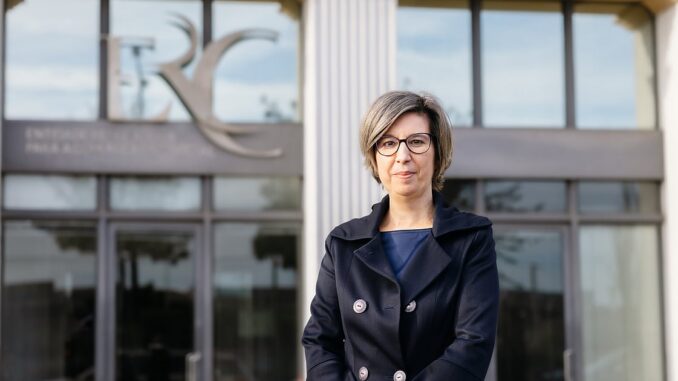
The diagnosis has been made and has not improved with regard to the treatment of women in the news, notes the regulatory entity, which annually receives “a few dozen” complaints and reports about gender inequality in the media.
Speaking to Lusa, on the sidelines of the conference “Gender and Media: evidence and trends 30 years later”, the president of the Regulatory Entity for Social Communication (ERC) acknowledged that the results of the latest edition of the Global Media Monitoring Project – the largest and oldest study on gender disparities in the media – “do not structurally change anything” that was already known about these asymmetries.
In fact, in some indicators there is “even a regression, a setback”, pointed out Helena Sousa, who participated in the opening session of the event in which the national results of the GMMP were presented, relating to 2025, which took place this Wednesday, February 25, at the Faculty of Social and Human Sciences of Universidade Nova de Lisboa.
National data from the latest edition of the GMMP – carried out by the non-governmental organization World Association for Christian Communication, in partnership with UN Women – reveals that only one in four news subjects is a woman, an even greater minority among specialized sources of information.
“On a routine news day, women make up just 24% of people visible in the news.” in Portugal, a percentage below the global average of the 94 countries where the study was carried out (26%), it is concluded.
This portrait comes after a decade of “positive evolution” and reveals “a significant decline compared to the 34% recorded in 2020”, the date of the previous edition of the GMMP.
“These are worrying data”, acknowledged Carina Quaresma, president of the Citizenship and Gender Equality Commission (CIG).
“We are not achieving a very clear evolution, something needs to be shaken up for there to be a change”acknowledged, pointing out that the greater presence of women in newsrooms does not mean more parity in public visibility.
“There is a long way to go”, he summarized, calling for the “social responsibility of media outlets” in order to reflect society as a whole.
Under its action plan to promote gender equality and combat discrimination, the ERC has generally responded with warnings to the complaints and reports it receives, especially because “there is still no sanctioning framework” to apply to gender inequality in the media, recalled Tânia Soares, director of the ERC’s Media Analysis Department, in the panel in which she participated.
Noting that “regulation does not have to be sanctioning” and that doing more than raising awareness “is outside the competences” of the ERC, Tânia Soares highlights, however, that the regulator “cannot compel, but can encourage the adoption of regulation plans” transversal to information and programming that promote parity and diversity.
At the same time, the ERC can implement a “national monitoring system, with indicators of gender in the media, for subjects and sources, but also commentators, basically for those who occupy the media space”.
Responding to questions from the audience, Tânia Soares said that the media “sometimes follow” the recommendations, but “in some situations” they do not and then the ERC makes “new notifications, reminding us of the situation”.
Helena Sousa considers that, in this context, “the regulator can and must continue to respond in the best possible way to the complaints and reports that are coming in” and seek “an increase in the work that is already being done” with the media, noting that public and private media bodies have, “from an ethical and deontological point of view, the same responsibilities”.
It is possible to “work more with the media”, he acknowledged, highlighting, however, that the ERC can only “act within the framework of legal powers”, which mainly involves “raising awareness”.
Initiatives like the GMMP, which brings together academics, researchers, journalists, regulators, are fundamental to dealing with “a social, structural problem of enormous depth”, he points out.
The GMMP carried out its last monitoring on May 6, 2025, collecting 30,049 news items in 94 countries, involving 58,563 people, carried out by 26,708 professionals.
In Portugal, 319 news stories were analyzed and, for the first time, a news agency, Lusa, was part of the study.
Leave a Reply