
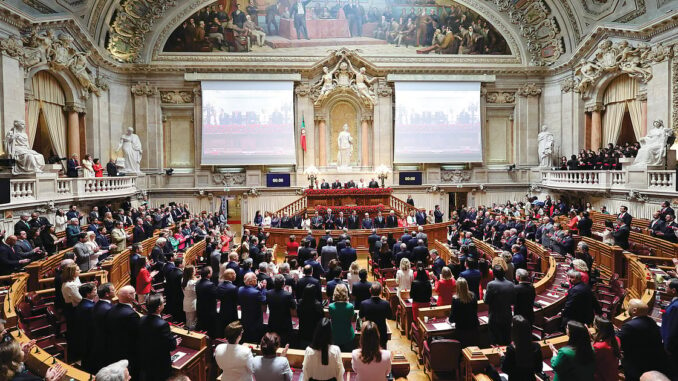
This Wednesday, the 25th, parliament debates the parliamentary assessment of Livre, PCP and BE so that the salaries of workers in companies in ‘lay-off’ are paid 100% and other measures to support the populations affected by the storms.
At issue is a parliamentary assessment that intends to amend the Government decree that created a simplified ‘lay-off’ regime for companies affected by the succession of storms that hit the country, presented on the 18th, and which has the support of Chega and PS.
In addition to the parliamentary assessment, deputies will debate a set of proposals presented by the opposition to support the affected populations, which include the exemption from IMI for the year 2026 in the affected municipalities, proposed by Chega and BE.
The blockers, who scheduled the debate, put forward a set of ten proposals that include extraordinary subsistence support greater than that provided by the Government, income assistance for those who have lost their own permanent housing or a daily supplement of 20% of the base salary for relief, cleaning, security forces or Armed Forces personnel.
The PCP is also debating an “intervention plan” with several measures to support populations with costs higher than those estimated by the Government and the PAN proposes an exceptional financial support regime for affected animal protection entities.
On Wednesday, in parliament, deputy Hugo Carneiro, from the PSD, asked the opposition for “common sense” and that it not want to replace the Government, warning that some of the diplomas could “collide with the brake law”.
The same warning was left by the parliamentary leader of the CDS-PP, Paulo Núncio, recalling this constitutional norm that prevents parliament from approving laws that increase expenditure or reduce budgeted revenue during the current economic year.
However, Chega, PS and the rest of the parliamentary left maintained their positions. André Ventura stated that he will try to convince the prime minister that the ‘lay-off’ must be paid 100%, but that if this does not happen he will vote in favor of the measure, even though he admits asking parliament for an assessment of its budgetary impact.
For the PS, deputy Miguel Costa Matos accused the Government of creating a problem that “does not exist” around the brake norm, arguing that this issue could be overcome with a rectifying budget, which the socialists have already expressed their willingness to approve.
Livre also referred the issue for possible rectification, if necessary, and the PCP rejected “formal excuses” for the measure not to be approved. BE rejected that the measures violate any constitutional norm and insisted that parliament must “honor the word” initially given by the Government.
On February 2, the Ministry of Labor had guaranteed in a statement that “workers in affected companies are guaranteed 100% of their normal net salary, up to three times the national minimum wage”.
In a statement sent to newsrooms on February 12, the Ministry of Labour, Solidarity and Social Security clarified that the “retribution compensation in case of reduction or suspension of the employment contract corresponds to two thirds of your gross salary, as long as it does not exceed three times the Guaranteed Minimum Monthly Remuneration (€2,760)”.
According to the rules of the Assembly of the Republic, in the case of presenting amendments to a Government decree-law, the proposals are sent to the competent parliamentary committee to discuss and vote on the specialty, without voting on the generality, “unless the Assembly deliberates the analysis in plenary”.
After the specialty, the changes go to a final global vote and, if approved, the decree-law is “modified in accordance with the law into which they are translated”, being sent for promulgation by the President of the Republic.
Leave a Reply