
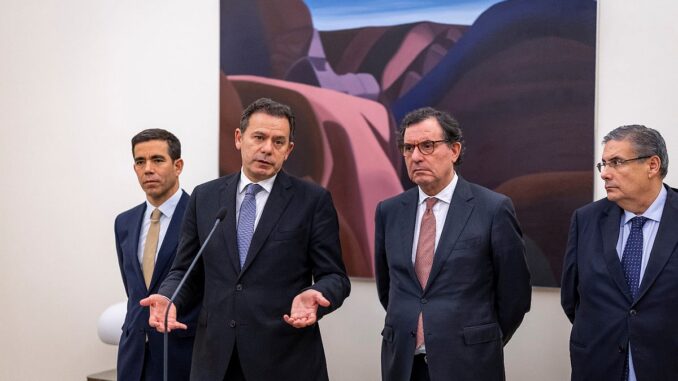
The Government did not close the door on the Amending Budget given the need to adapt the initial forecast of support to the needs of the population after the period of bad weather that hit the country, causing a trail of devastation. It was a topic of conversation with António José Seguro at Tuesday’s meeting and now Luís Montenegro has in hand the guarantee that, if he deems it necessary, there is parliamentary support for this.
Late this Wednesday afternoon, the government did not want to emphasize the Rectification. After the marathon of meetings with the parties, Luís Montenegro only mentioned “national financing, including the State Budget and possible debt issuance” – thus opening the door for more debt to cover the expenses caused by the bad weather.
“We do not want financing that puts at risk a path towards balancing public accounts, but that does not mean that there cannot be negative fiscal balances or an increase in the public debt ratio,” he said. “I’m not saying there will be, I’m saying that we don’t exclude this possibility if the plan and investments require it”, he added.
The head of the Government explained that the Executive did not want to set deadlines, valuing short-term actions, projects until 2029 and structural interventions that could last until 2034. The Prime Minister also praised the “availability demonstrated by political parties”, stressing that it was understood that Portugal could not limit itself to “the most urgent recovery”, but rather “an opportunity to create solutions to face adverse situations in the future.”
Admitting the possible deficit, Montenegro highlighted that there are national and European funds and, on the one hand, guarantees that there are “ongoing negotiations with the European Investment Bank for new lines of financing for municipalities” and that “it will not stop presenting applications” for a reprogramming of the PRR in Europe, highlighted that the European Union Solidarity Fund will not represent more than “a few tens of millions of euros.”
Rectification will pass
The Executive leader knows, however, that any Amending Budget will be guaranteed approval. José Luís Carneiro, general secretary of the PS, left the meeting, in São Bento, saying that he makes this document viable as long as it is possible to follow the government’s performance in Parliament month by month, which was approved the previous day in plenary.
As such, the PS made it very clear that it was pleased to see that two thirds of the measures are “taking advantage of, and also valuing”, the PS proposals. In the document they delivered to Montenegro, the socialists highlighted that, “Although the principle of balancing public accounts is essential and constitutes a pillar of government responsibility, the Socialist Party considers it equally essential that the people and companies affected are supported. For this reason, the PS expressed, if necessary, its willingness to make an Amending Budget viable. Despite this, they harshly criticized the Government’s PTRR.
Different versions for Leitão and Ventura
Before Carneiro, in São Bento, Mariana Leitão, president of the Liberal Initiative, raised the possibility of Montenegro moving forward with the Amending Budget. “Regarding the Rectification, Mr. Prime Minister does not completely exclude the hypothesis, but there is a set of values that are still being determined, which will be presented, we were told, during the month of March. Only then will the decision be made,” he said, adding that he would support the budget review: “Immediately, it is very important that we respond to the people. Greater support is needed for destroyed homes and affected businesses, also due to the lack of workers.”
André Ventura had already guaranteed that he would be available for a rectification, he said he was willing to “work together quickly”, but he said he would not give up on the 100% paid lay-off because it was a “commitment”, understanding that backing down would generate “instability”. However, he left the meeting saying that the Government “continues to believe that it is not yet necessary”, highlighting that Chega “has a slightly opposite position.” As such, what could happen remains unclear, a situation made worse by the clinical situation of Miranda Sarmento, finance supervisor.
André Ventura advanced the “opening of the Government” to a perimeter for the areas where it would be applied, which represents a possible recognition that the State of Calamity could be extended to more areas. There is a split in tolls between the two parties.
Jorge Pinto took proposals to the prime minister. Livre wants emergency social reinforcement, spoke about the importance of distributing emergency kits, developing the reference radio and, both Rui Tavares and Isabel Mendes Lopes agree that the correction can respond to “the extraordinary moment we are living in.” The Left Bloc, led by José Manuel Pureza, highlighted openness to dialogue for Montenegro at the meeting in São Bento and the party left behind the idea of being able to increase support.
Montenegro assumes the possibility of debt
Therefore, it was clear that the decision was in the hands of Montenegro and Miranda Sarmento, since they already have guarantees of a parliamentary majority to approve the Amendment. Even so, the Government, at the end of the afternoon, preferred not to emphasize the Amendment. After the marathon of meetings he mentioned “national financing, including from the State Budget and possible debt issuance”.
“We do not want financing that puts at risk a path towards balancing public accounts, but that does not mean that there cannot be negative fiscal balances or an increase in the public debt ratio,” he said. “I’m not saying there will be, I’m saying that we don’t exclude this possibility if the plan and investments require it”, he added.
The head of the Government explained that the Executive did not want to set deadlines, valuing short-term actions, projects until 2029 and structural interventions that could last until 2034. The Prime Minister also praised the “availability demonstrated by political parties”, stressing that it was understood that Portugal could not limit itself to “the most urgent recovery”, but rather “an opportunity to create solutions to face adverse situations in the future.”
Admitting the possible deficit, Montenegro highlighted that there are national and European funds and, while on the one hand, guarantees that there are “ongoing negotiations with the European Investment Bank for new lines of financing for municipalities” and that “it will not fail to present applications” for a reprogramming of the PRR in Europe, it highlighted that the European Union Solidarity Fund will not represent more than “a few tens of millions of euros.”
Leave a Reply