
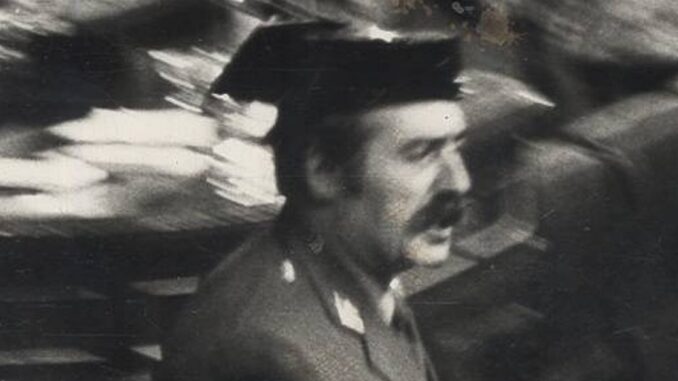
Former civil guard Antonio Tejero, who in 1981 kidnapped the Spanish government and deputies inside parliament for 17 hours, in a failed coup attempt, died this Wednesday, February 25, at the age of 93.
The death of former lieutenant colonel Antonio Tejero Molina of the Guardia Civil (corresponding to the Portuguese GNR) was confirmed to the Spanish media by the family’s lawyer, Luis Felipe Utrera Molina.
On February 23, 1981, Antonio Tejero led an attempted coup d’état filmed by Spanish public television (RTVE) cameras installed inside the plenary room of the Spanish parliament.
The image of the then civil guard entering the Congress of Deputies (lower house of parliament/Cortes) with a pistol in hand that day remained in the history of Spain and 23-F (as the failed coup d’état attempt of 1981 is known) is one of the episodes considered most striking and decisive of the so-called “Spanish transition” from the Francoist dictatorship (led by General Francisco Franco, who died in 1975) to democracy.
After the coup attempt, Tejero was tried and convicted of military rebellion, along with two former generals Alfonso Armada and Jaime Milans del Bosch.
Tejero was sentenced to 30 years in prison and was released from prison, with parole, in 1996, after serving half of his sentence.
It last appeared in public in 2019, on the day that Franco’s body was removed from the basilica of the Valley of the Fallen (a place on the outskirts of Madrid that is one of the greatest symbols of the Spanish dictatorship) and taken to a cemetery in the town of El Pardo.
Tejero joined those nostalgic for the dictatorship that day in protest against the removal of Franco’s body from the Valley of the Fallen near the entrance to the cemetery.
On February 23, 1981, Tejero, who led around 200 civil guards who accompanied him, interrupted the parliamentary session during which Leopoldo Calvo-Sotelo should have been installed as the new leader of the Government of Spain, following the resignation of then Prime Minister Adoldo Suárez.
History has left, among other moments, the cry “Everybody quiet!”, which Antonio Tejero launched when he ascended the parliament rostrum after pushing away Defense Minister and superior General Manuel Gutierrez Mellado, who faced him and tried to stop him.
There followed 17 hours of kidnapping inside the parliament of 350 deputies and all members of the Government, as well as employees and journalists, among others, until the surrender of Tejero and his men, around noon on February 24th.
At those times, the civil guards even fired shots into the ceiling and asked everyone present to lie down on the floor, an order that three men did not comply with: Adolfo Suárez, Gutierrez Mellado and the then leader of the Spanish Communist Party, Santiago Carrillo, who remained seated in their respective places in the plenary, this being another of the images of that day that remained in the recent history of Spain.
The short speech that the then King of Spain Juan Carlos I made on television during the early hours of the morning, in which he defended the constitutional order and democracy, was considered decisive for the failure of the coup and the surrender of Antonio Tejero.
23-F transformed Juan Carlos I into one of the heroes of the Spanish transition and guarantor of democracy in Spain, although in recent years his true role in this episode has been questioned by several protagonists, including Tejero himself, who said that he was used by Alfonso Armada, the King’s former tutor and head of the Royal House.
Alfonso Armada intended to head a unity government that emerged from the coup d’état, something that, in Tejero’s version, the general had said was agreed with Juan Carlos I.
Juan Carlos I, who abdicated in 2014, publicly gave his own version of 23-F for the first time in the memoir he published last year, where he claims to have been betrayed by Alfonso Armada.
“Alfonso Armada was by my side for 17 years. I really liked him and he betrayed me. He convinced the generals that he was speaking in my name”, he reported.
What Spanish justice proved was that the coup had been orchestrated by the two generals and by Tejero, with Alfonso Armada always denying having been the mastermind of the operation.
“The Crown, a symbol of the permanence and unity of the country, cannot tolerate in any way the actions or attitudes of people who seek to forcibly interrupt the democratic process”, stated Juan Carlos in the message broadcast on television at the time.
From that moment on, it became clear that the coup would be a failure and the coup plotters surrendered hours later.
Before 23-F, Antonio Tejero had already been convicted of participating in “Operation Galaxy” in 1978, a conspiracy that also intended to carry out a coup d’état with an assault on the Moncloa Palace, the headquarters of the Spanish Government.
Leave a Reply