
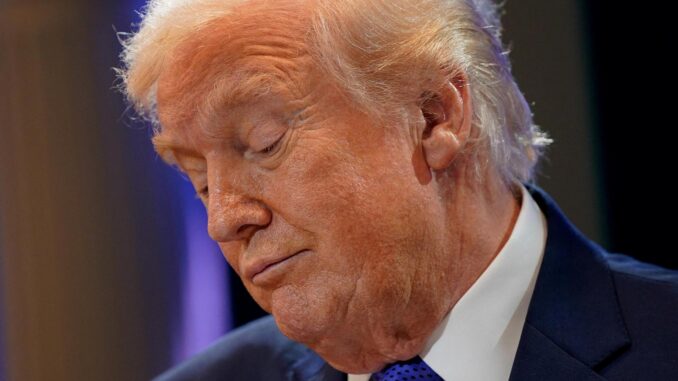
Many citizens of Europe, even those who live in the continent’s most Atlanticist countries, recognize that the United States can no longer be considered an ally. What’s more: only one in four Europeans currently perceives Washington as such.
These are, at least, the conclusions drawn by two long-awaited multinational surveys published last week: the CITRUS reportprepared by a think tank called the European Council of Foreign Relations (ECFR), and a survey carried out by the London company Public First in collaboration with the magazine Politico.
The data collected by the ECFR is quite clear in this regard: in countries like Denmark, the United Kingdom and Poland, historically close to Washington, a high percentage of citizens –58%, 53% and 47%, respectively– has gone from seeing a “reliable ally” in the United States to simply seeing a “necessary partner” from whom we should not expect too much.
They are the benevolent ones, because in other parts of the continent popular sentiment is much more hostile. 39% of the Swiss now consider the Americans a “rival” and even an “adversary”, for example. In France and Germany, the two great European powers, this percentage stands at 28%.
As far as Spain is concerned, ECFR analysts have compiled data that says that today only 10% of Spaniards consider the United States an ally of the European Union. 50% put him in the category of “necessary partner”, 15% see him as a “rival” and 13% opt for the definition of “adversary”.
“The efforts of Donald Trump to redefine consolidated international relations – especially in Europe – are distancing traditionally loyal allies,” they point out. Erin Dohertydata analyst at Politico, and Nicholas Vinocurthe magazine’s chief correspondent in the Old Continent.
“The deterioration of the United States’ reputation raises new questions about the stability of the global order that has existed for decades and about the country’s strength on the world stage,” they add.
For your part Célia Belinco-author of the CITRUS report and director of the ECFR office in Paris, wanted to focus on the political cost that all this data can have for European leaders: “They continue to give in to Washington to avoid a rupture, but our survey shows that the cost is increasing.”
He adds: “His moderate response to US provocations risks eroding confidence not only in the leadership, but in Europe itself, its unity, its power and its future.”
Furthermore, American military power is increasingly perceived as an uncertain asset. The poll conducted by Public First and Politico indicates that more and more people in France and Germany do not believe that their potential enemies will reconsider attacking Paris or Berlin for fear of American retaliation.
That is to say: American reprisals are no longer perceived as a guarantee of security in the Old Continent.
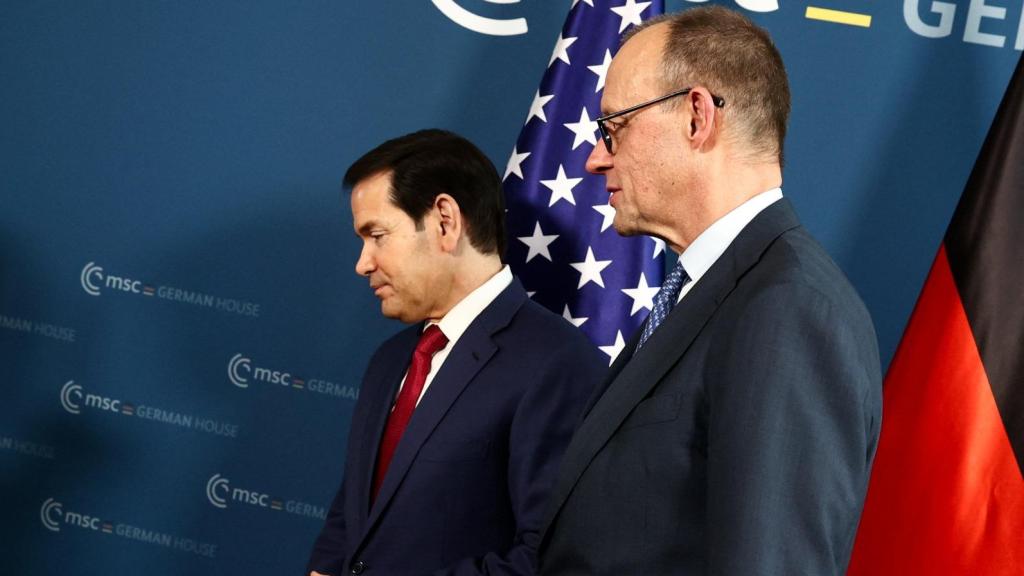
Merz asks in Munich to repair the relationship with the US and announces talks with Macron for a European nuclear shield
Another fact: in just one year there has been a marked 10% drop in the proportion of British citizens who still consider the United States to be an effective deterrent against enemy attacks.
In line with this, it appears that the majority of European citizens support an increase in defense spending, with a substantial portion also supporting re-implementing conscription – something Germany has already done to some extent – and even developing a continental-scale nuclear deterrent force.
In that sense, and according to the data collected by the ECFR, those who most support this type of initiatives are the Poles (68%), the Danes (63%) and the British (59%). Estonians (56%), Portuguese (57%) and Germans (55%) follow. In front of all of them would be Italy, where only 26% of public opinion seems to be in favor of rearmament.
And in Spain? Always according to the ECFR, our country is divided in two: 45% would be in favor of increasing defense spending while 44% are against doing so.
Macron warning
Curiously, both multinational polls have coincided in their appearance with an interview given by the French president, Emmanuel Macronto several European newspapers. In it, the French leader attacked what he described as “threats and intimidation” by Washington.
Macron also took advantage of his intervention to warn other European leaders that transatlantic relations will hardly return to normal in the short term.
Likewise, its publication took place days after the opening ceremony of the Winter Olympic Games that are being held these days in Milan.
There the American vice president, JD Vancewas greeted with boos and whistles. A welcome that the head of European diplomacy, Kaja Kalladefined it as a display of “European pride” in the face of the “unkind words” directed at Europe from the US Government.
“Last year, European public opinion considered the United States to be an unreliable but crucial ally, capable of deterring its enemies despite its certain unpredictability,” he says. Seb Wridehead of polls at Public First. “But now, far from taking for granted the transatlantic deterrence offered by the NATO alliance, European public opinion hardly believes it exists.”
To all of the above we must add the information that has appeared in recent hours saying that the United States has reoriented its foreign financing program to try to export Trumpist ideology to Europe.
In other words: there is an indeterminate but increasing number of think tanks ultraconservatives and political groups associated with the new radical right that are positioning themselves to receive funds from Washington.
According to the US press, several State Department officials have already maintained preliminary contacts on public financing with representatives of a think tank French called Western Arc and with a British association called Free Speech Union.
These approaches have been based, always according to the North American press, on a list provided to US officials by the ultra-conservative Heritage foundation, based in Washington, where public figures and institutions “related” to the positions – very hostile – that Trump maintains in relation to the European Union appeared.
If confirmed, these movements would reinforce the perception that the current US Government is not only redefining its relationship with Europe but also trying to actively influence its internal political debate.
Leave a Reply