
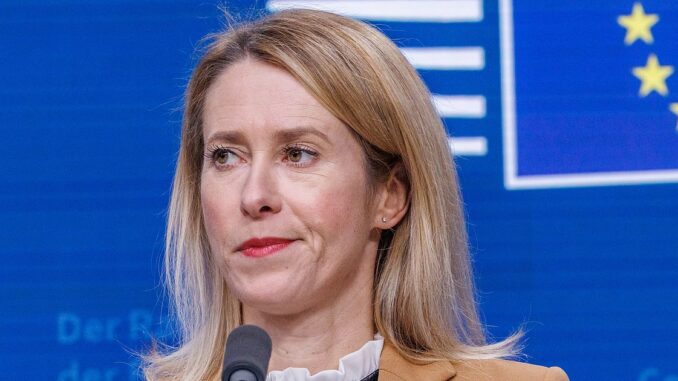
The head of EU diplomacy, Kaja Kallas, ruled out that foreign ministers will be able to approve the 20th package of sanctions against Russia today, contrary to what was planned, due to Hungary’s opposition.
“We will discuss the 20th sanctions package, but, as everyone knows, there will be no progress on this matter today. But we will certainly insist on this issue”, said Kaja Kallas in statements to journalists upon arrival at a meeting of European Union (EU) foreign affairs ministers in Brussels.
The EU High Representative for Foreign Affairs and Security Policy was referring to the sanctions package that had been prepared for approval at today’s meeting, on the eve of marking the fourth anniversary of the war in Ukraine.
However, this Sunday, Hungarian Foreign Minister Peter Szijjarto announced that he would block the adoption of this package, accusing Ukraine of preventing deliveries of Russian oil to his country through the Druzhba pipeline.
Kaja Kallas stated that the EU is “doing its best” to be able to adopt this sanctions package, noting that it has already spoken to several Member States who promised to talk about this issue at today’s meeting and try to “convince the countries that are blocking”.
“But we heard very strong statements from Hungary, so I don’t see them changing their position. Unfortunately, that’s the position they have,” he said.
Asked what kind of commitments the EU is willing to make to convince Hungary to change its stance, Kaja Kallas noted that Budapest’s justification for the blockade – linked to the Druzhba oil pipeline – “has nothing to do with the 20th sanctions package”.
“So, I think we shouldn’t relate things that have nothing to do with each other. But let’s listen to their explanations, the reasons they give for the blockade, and then we’ll see what possibilities we have to overcome them,” he said.
European Union Foreign Ministers (MNE) are meeting today to decide whether to impose a new package of sanctions on Russia and whether to move forward with measures against Israel due to the expansion of settlements in the West Bank.
The beginning of this Council on Foreign Relations began at 9:45 am (8:45 am Lisbon) and will have only two topics on the table: the war in Ukraine and the situation in the Middle East, particularly in Iran, Syria, Israel and Palestine.
As regards Ukraine, ministers are meeting on the eve of the fourth anniversary of the war, and it was expected that they would decide to impose the 20th package of sanctions on Russia, before Hungary expressed its opposition.
The initial sanctions proposal had been presented by the President of the European Commission, Ursula von der Leyen, on February 6 and included financial and commercial restrictions, but also a total ban on maritime services for crude oil – a contentious point for countries like Greece or Malta, with strong maritime industries.
Leave a Reply