
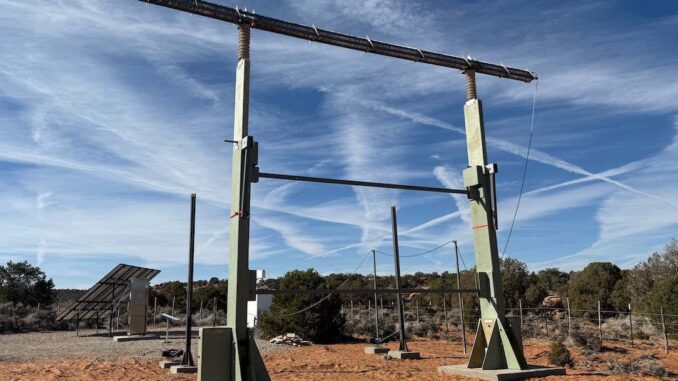
Weather conditioning equipment used by Rain Enhancement Technologies in Utah
Rain Enhancement Technology
States like Utah in the western US are suffering record snow droughts, raising concerns about wildfires and low flows in the key Colorado River. But a start-up that releases negatively charged aerosols that can be carried into clouds claims to have increased snowfall by 20 percent in one Utah mountain range.
Rain Enhancement Technologies compared snowfall in the La Sal and Abajo mountains 70 kilometers to the south during five recent dry winters. When the company operated its high-voltage ionization field upwind of the La Sal Mountains in January, the mountains received 9 centimeters more snow than expected given the amount of snow the Abajo Mountains received, the company says.
However, the researchers caution that these results may have occurred by chance and it is too early to tell how well the technique works.
“Cloud-seeding operations have been active for some time, and we’re offering another way to increase precipitation … but one that doesn’t involve any chemicals,” says a company meteorologist. Jeff Chagnon. “Also, we don’t have to fly into the clouds… We can simply flip a switch from anywhere in the world and work for about 48 hours at a time.”
The United Nations warns that the world is entering an era of “water bankruptcy”, with up to 3 in 4 people facing water shortages or contamination. Countries like Iran, where water shortages have helped fuel bloody protests, are trying to induce more rain by spraying salts such as silver iodide from planes. Nine US states also have cloud-seeding programs.
However, the public is often concerned about the unknown health effects of silver iodide, which is released in large quantities, while conspiracy theories surrounding “chemtrails” foster distrust of alleged weather modification programs. Ten US states have cloud seeding banned or being considered.
Rain Enhancement Technologies feeds 10,000 volts of electricity through coiled wire suspended between a pair of 8-foot poles. Tiny aerosols like dust, soot, or salt pick up electrons when they blow near this wire, just as your feet can get charged when they rub against carpet. The wind then carries some of these ionized particles up into the clouds.
Water naturally condenses into aerosols in clouds, creating droplets that move and bump into each other. If they stick together, they can fall to Earth as rain. However, the droplets often do not stick together, so they remain too small for gravity to overcome the updraft that keeps them aloft.
But electrically charged droplets—even those with the same charge— interact to create polarity, with the negative side of one drop attracting the positive side of another. When droplets condense around Rain Enhancement Technologies’ negatively charged aerosols, the attraction between them accelerates the rate of collisions and coalescence that produces rain, according to Chagnon.
This technology cannot control the upward movement of air that creates clouds and rain. “But once the cloud is formed, we can get a little more water out of it,” Chagnon says.
Evidence from the Cold War suggested that electric charge could enlarge cloud droplets. A 2020 analysis found that the UK’s Shetland Islands saw 24 per cent more rain on days when radioactivity from nuclear bomb tests ionized the air.
Trial of Rain Enhancement Technologies in Oman from 2013 to 2018 rainfall increased by 10 to 14 percentdepending on the statistical analysis used, the study found. An experiment that scattered negative ions from a similar field in China claimed it did increased precipitation by about 20 percent.
But the World Meteorological Organization warns that while salt dispersion in winter clouds has been shown to affect precipitation, the ionization approach still lacks scientific proof.
“It’s interesting that they saw something consistent with cloud modification,” he says Edward Gryspeerdt at Imperial College London. “But because precipitation, snowfall, and rainfall are incredibly variable, there’s always a good chance that the effect they saw was just a fluke.”
The five dry years that Rain Enhancement Technologies used to set a baseline in the Utah mountains may not be enough to fully account for how much difference can be seen in snowpack at different times of the year, he says Jeff French at the University of Wyoming.
“I would wait for more experimental studies and more years to confirm the validity of ionization as a catalyst for more snow,” he says Ibrahim Oroud at Mutah University in Jordan.
topics:
Leave a Reply