
The keys
nuevo
Generated with AI
nuevo
Generated with AI
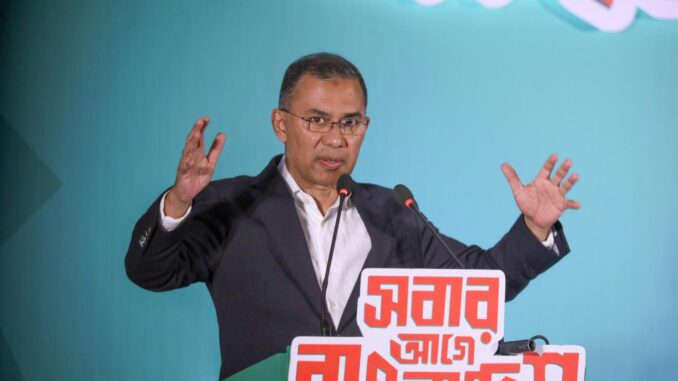
With his victory, Tariq Rahman breaks with more than three decades of female alternation at the head of the Bangladeshi Government, after her party, the Bangladesh Nationalist Party (BNP), has obtained a comfortable victory that has given him an absolute majority.
The figure of Rahman, a 60-year-old politician, is directly linked to his self-imposed exile in London, where he has remained since 2008.
Since the moment he left the country, his image has been linked to that of the leader persecuted by a judicial system that tries to punish the opposition, while others perceive him as a fugitive who tries to evade the work of justice.
The BNP leader left Bangladesh after being prosecuted on charges of corruption, money laundering, arms smuggling and for allegedly organizing an attack.
dynastic heritage
The new elected president comes from one of the most influential dynasties in national politics in the Asian country.
Supporters of the Bangladesh Nationalist Party (BNP) make the victory sign in front of a banner with the image of Tarique Rahman.
Reuters
Rahman is the son of Jaleda Ziawho served as prime minister for two terms, and Ziaur Rahmanconsidered a hero of the war of independence and president of the country between 1977 and 1981, the year in which he was assassinated during a failed military coup attempt in Bangladesh.
Trained in Business Administration, he has always projected a different image from that of his mother, Jaleda Zia, who was a more charismatic politician.
Those around him describe him as a reserved and methodical leader, more comfortable in strategic calculation than in fiery rhetoric.
Its strength does not lie in the large rallies, but in the internal engineering of the party: organizing cadres, closing pacts and directing the political machinery with patience and method.
From London exile, he has consolidated a shadow leadership. Although he did not hold institutional positions in the country, he serves as interim president of the BNP and maintains strategic control of the party through telematic meetings and extensive activity on social networks.
His British residency has allowed him to operate more freely, but has also fueled internal criticism about the feasibility of spearheading a national project from abroad.
For years, the Bangladeshi justice system banned local media from broadcasting content or images related to Rahman, whom they considered a fugitive from justice.
That scenario changed after the wave of protests in 2024 and the subsequent political turn: several of the sentences against Tarique Rahman were overturned by the courts, clearing the way for his return and reconfiguring the political chessboard in Dhaka.
After the political decline of Sheikh Hasinathe courts reviewed the open cases and annulled the sentences against the leader, clearing the way for his return to Bangladesh, which occurred on December 25, allowing him to run in the elections.
The return of the so-called “prodigal son” still divides the country: for its supporters, it represents the reparation of an injustice and the return of a reference removed for political reasons; For its detractors, it confirms that Bangladeshi public life continues to be trapped in the alternation of competing elites.
Tarique Rahman’s support base combines tradition and renewal. On the one hand, the historic BNP apparatus once again mobilized its territorial networks and its loyal electorate.
Added to this are conservative sectors critical of the previous stage and a part of the young vote activated after the 2024 protests in Bangladesh, who saw in his candidacy a way to accelerate the political changeover and achieve reforms in the country.
More than a formal pardon, the judicial annulment of the sentences transformed his exile from a symbol of persecution into a prelude to return, reinforcing his aspiration to lead a new era in the Bengali republic.
Leave a Reply