
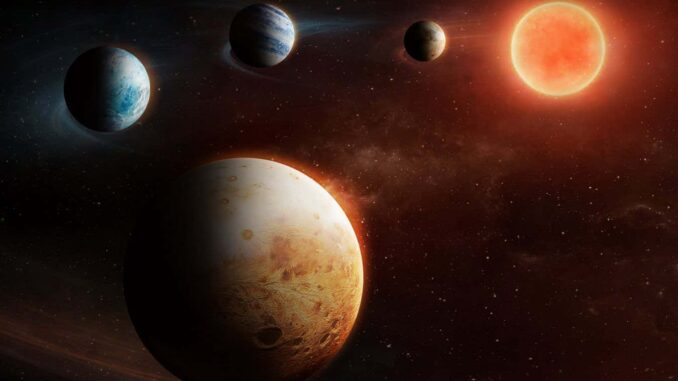
An artist’s impression of the planetary system around the star LHS 1903
ESA
Astronomers have found a planetary system that appears to have formed inside out. While most systems like our own have rocky planets closest to their star and gaseous planets farther away, the LHS 1903 system has a rocky world at its edge that challenges established models of planet formation.
The most distant of the system’s four planets wasn’t immediately apparent in the first observations from the Transiting Exoplanet Survey Satellite — those first measurements allowed researchers to identify one rocky planet slightly larger than Earth near the star and two gaseous planets slightly smaller than Neptune. But when Ryan Cloutier at McMaster University in Hamilton, Canada, and his colleagues monitored the system using eight other observatories and discovered telltale signs of a fourth world that is slightly larger than the other rocky planet in the system.
This rocky world, which is further from the star than its gaseous siblings, was unexpected. “These systems are not unheard of, but they are rare—and systems that have this unique architecture and that we can characterize in detail are extremely rare,” says Cloutier.
These details, including the size of the planets and the fact that they all orbit their star in periods shorter than 30 Earth days, have allowed researchers to test models of how these planets might have formed. “Manufacturing one planet can be done by several mechanisms, but once you need to produce four different ones, you can start to differentiate between different models,” he says. Solène Ulmer-Moll at Leiden University in the Netherlands. “You found a model that can explain them all.
Most systems are thought to form all their planets at about the same time from the same disk of dust and gas. The sizes and compositions of planets depend on where they formed within the disk and what events, such as collisions with other worlds, happened to them afterwards. However, this model does not work for the LHS 1903 system.
If the LHS 1903 planets were born in the traditional way, the outermost one should have formed with a thick gaseous envelope like the middle two. This atmosphere could have been lost in a collision or bombardment with radiation, but the researchers’ simulations show that such a process would also remove gas from one or both of the inner planets.
“It’s really difficult for you to form the most distant planet without affecting the gas planets that are closer to the star,” says Cloutier. But the orbital dynamics of the system make it extremely unlikely that any of the planets were not born from the same disk.
Cloutier and his team found that the most likely way to form this system is through a process called “inside-out” planet formation. Here, one planet forms and then migrates inward toward the star, making room for the next planet, and so on. This takes time, so planets are born in different environments as the protoplanetary disk evolves. “That last planet, if it takes long enough, formed in an environment where no gas is available,” Cloutier says. This system shows how diverse the processes of planet formation can be in the universe, he says.
topics:
Leave a Reply