
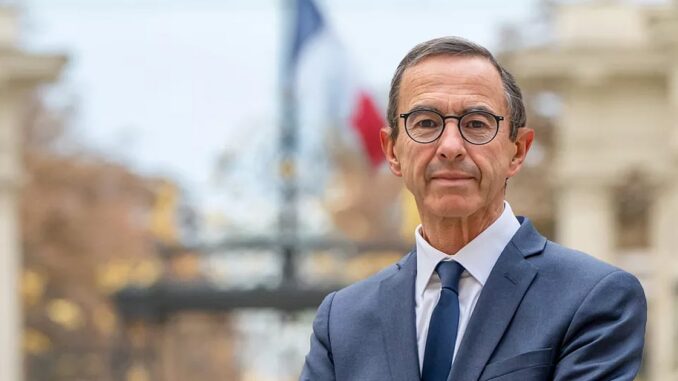
In the middle of the pre-election campaign for the municipal elections on March 15th and 22nd, the leader of The Republicans (center-right) decided not to wait any longer and announced his expected candidacy for president, in a field filled with candidates. The former Minister of the Interior promises a “new path based on order, prosperity and French pride”. A speech that tries to capture the far-right electorate, who will only know who will vote in July, when the courts decide on Marine Le Pen’s ineligibility.
In a speech broadcast live on social media on Thursday, Retailleau began by painting the political landscape of “a France that is sinking, a France that is erased, in an increasingly threatening world”.
He continued: “To the east, Vladimir Putin is sowing war on our doorstep, and China, in turn, is infiltrating and weaving its web in the heart of our continent. To the west, Donald Trump is imposing his brutal law and threatening the very unity of our continent. For its part, the Islamist international spreads terror in the countries it dominates, also seeking to infiltrate our societies. In the face of all these threats, Europe has a role to play. However, it must defend its identity, his project and put an end to his technocratic drifts”, he defended.
Looking at his country, Retailleau highlighted immigration, social security reform, the competitiveness of the economy and education as the biggest problems. “Immigration is not an opportunity. Because beyond a certain number, a multicultural society always becomes a society of multiple conflicts.” In 2024, 11.3% of the French population, or 7.7 million people, were immigrants. Almost half of African origin.
“Telling the truth is saying that you cannot live better by working less; that the State cannot spend more than it earns.” The government led by Sébastien Lecornu was forced to suspend the pension that increases the age of active life in exchange for the survival of the minority executive.
“It is the competitiveness of our companies that allows wages to increase. There can be no social progress without national prosperity”, he continued. Finally, he spoke out against “shame” in the education sector: “Our school has become a machine for reproducing inequalities, as now the success of children depends on the social position of their parents.”
Having created a portrait of the world and the country, Retailleau has committed to presenting during the election campaign the themes of a “new social contract” that he intends to take to a referendumas well as the respective calendar. Objectives: “Dramatically reduce immigration, initiate a true revolution in our criminal justice and return priority to our national law whenever it comes to protecting our fundamental interests.” However, the current legislation on the referendum would have to be changed, as issues such as justice or immigration are not covered.
Later, in an interview on TF1, Retailleau gave southern European countries as an example to follow. “Just a few years ago, they fell a lot more than us, they made a jump and now they are much better.” The former minister did not specify which model to follow, but the southern European country that recorded the greatest growth was Spain, under a socialist government, and with a policy of openness to immigrants.
Bruno Retailleau, 65, had long dreamed of running for president. In 2021, still little known to the general public, he withdrew from participating in the right-wing primaries. Now, after taking on a role in major media — Minister of State and Interior in three governments — and as leader of the Gaullist Os Republicans, he has decided not to wait for the process chosen by the working group, appointed by him, to decide how to nominate the party’s candidate.
“There are right-wing candidates everywhere. There are almost a thousand Maoist flowers,” said Laurent Wauquiez, head of the party’s parliamentary group, in January, in reference to Mao Zedong’s “hundred flowers campaign”. Wauquiez himself does not deny his presidential ambition, defending the holding of primaries extended from the center-right to the extreme right. The candidacy of the president of the Hauts-de-France region Xavier Bertrand is added; and the intentions of the president of the mayors’ association David Lisnard, former prime minister Dominique de Villepin, who launched the Humanist France party, and former European commissioner and fugitive prime minister Michel Barnier.
From knight to director
Retailleau was born and raised in the Vendée, a department in western France. Grandson and son of mayors from the village of Saint-Malô-du-Bois, both cereal traders, he graduated in Paris, at SciencesPo, in Public Service, and obtained a master’s degree at the University of Nantes, in Economics. His professional and political career is closely linked to Philippe de Villiers, politician and founder of the Pays du Fou amusement park. Young Retailleau, who started out as a rider in the park’s main show, Cinéscénieended up as director of show and the park. Villiers’ right-hand man, he accompanies him in his Movement for France party, as well as in the two presidential candidacies of this man from the conservative right and against European integration.
He also follows in his footsteps as an elected official in the region, starting in the 1990s, holding the positions of departmental advisor, vice-president and president of the Pays de la Loire regional council, president of the Vendée council, and in between being a deputy (1994-1997). In 2010, he broke with Villiers and joined the UMP (currently The Republicans), a movement for which he has been elected senator since 2011.
Reading instead of the pigsty
Catholic, he has been married to Isabelle since 1987, a doctor who does not renounce her private life, as do her three children. In Saint-Malô-du-Bois, in the family home where he spends his weekends, he is a nocturnal reader in his office, an old pigsty transformed by his father and by him, in the 1980s, according to the The World. Despite being a defender of some ideas proposed by the extreme right, his culture and ways disarm the left, or at least the moderate left.. Socialist colleagues in the Senate said, in the same text in the French evening newspaper, that “on social issues, he is reactionary in the literary sense, but he is a republican with whom one can argue” (Patrick Kanner) and that he is “at the extreme end of the right-wing spectrum, but he is not dishonest” (Laurence Rossignol).
Leave a Reply