
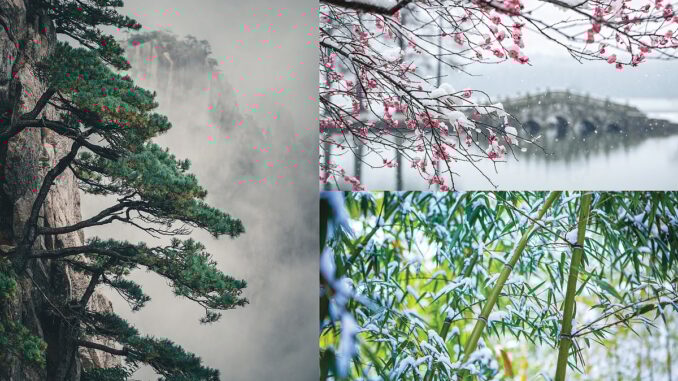
In the rigors of winter, when everything seems to be withering away, there are plants that overcome the intense cold and resist with tenacity, revealing remarkable vitality: the pine, the bamboo and the plum tree.
Although they have different shapes, the three share the quality of not fearing frost or snow, which is why they are known as the Three Friends of Winter. They appear frequently in Chinese poetry, literature, painting and calligraphy, serving as a metaphor and praise for those who maintain high moral integrity in times of adversity.
At the same time, they are widely used as auspicious motifs enshrined in Chinese craft objects, such as porcelain and furniture.
Pinheiro
At Christmas, it is customary for Western families to place a Christmas Tree at home, traditionally a fir or a spruce – evergreen trees that, in Chinese, are often referred to generically as “pines” or “Christmas Pines”. Decorated with colorful lights and gifts, the Christmas Tree becomes a symbol of joy and rebirth.
As for Western literature and art, the pine tree often appears in vast forests or mountainous landscapes, representing the strength of nature and the spirit of freedom.
In China, the cultural image of the pine tree is something different, symbolizing longevity and perseverance. The pine tree grows slowly, but remains upright for hundreds or even thousands of years, remaining evergreen throughout the four seasons. Due to its image of strength and reliability, it is often planted in ancient temples, imperial gardens and courtyards, as a faithful guard.
Leave a Reply