
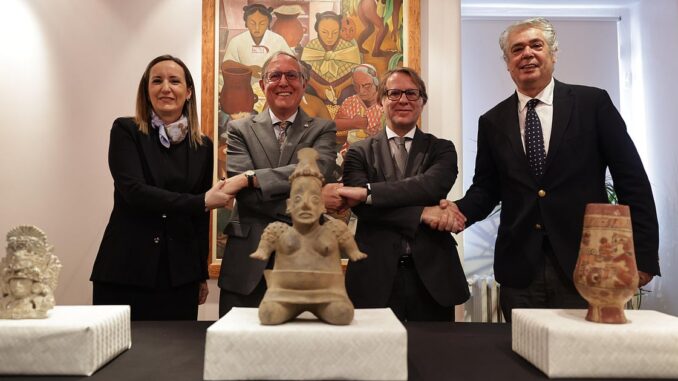
According to the archaeologist, microscopic analysis revealed traces of pigments in several parts of the body, suggesting that the figure was originally painted..
“This tells us about ideas of power, not only due to the type of pigment, but also the coloring”, adds Aline Lara. The details on the shoulders and the ceramic ornamentation associate the figure with warrior elites, allowing the reading of female representations linked to military power. “There are probably representations of women as warriors, which tells us about femininity and many feminine aspects related to war”he adds.
According to a note from the Mexican embassy, ”many ancient societies associated the feminine not only with motherhood or fertility, but also with powerful forces such as war, protection or destruction. In this sense, the figure can express dual symbolism (life and death, creation and destruction), without this meaning that it is a direct representation of a combatant.”
Part authentication combined traditional methods and advanced technologies. Manufacturing techniques, polishing, patina, natural wear, clay composition and pigments were analyzed.
“It was found that the pieces followed documented pre-Hispanic processes, such as hand modeling, the type of clay roller and pigments applied with a brush”, adds the archaeologist. The team also used digital photogrammetry to recreate three-dimensional models and portable microscopy for color analysis.
Armrest between private collecting and heritage
The case reignites the debate about private collecting of archaeological artefacts. In this context, ambassador Bruno Figueroa Fischer criticizes the logic behind the market.
“By feeding the ego of collectors, a piece is removed from a context that is lost”describes.
In a note to DN, the ambassador calls on collectors to voluntarily return pieces acquired without export documentation.
Aline Lara goes a little further when stating that the private market “funds the destruction of archaeological heritage” and that some European countries are “accomplices in this loss of information and identity” by allowing the circulation of pieces without clear provenance.
In this way, the restitution of these pieces opens a debate on the role of States, markets and collectors in preserving world heritage.
For now, the restitution of these three artefacts, as João Oliveira highlighted, is, first and foremost, “a procedural act of return”. But for Mexico and the scientific community, it is a symbolic step in recovering a dispersed memory.
Leave a Reply