
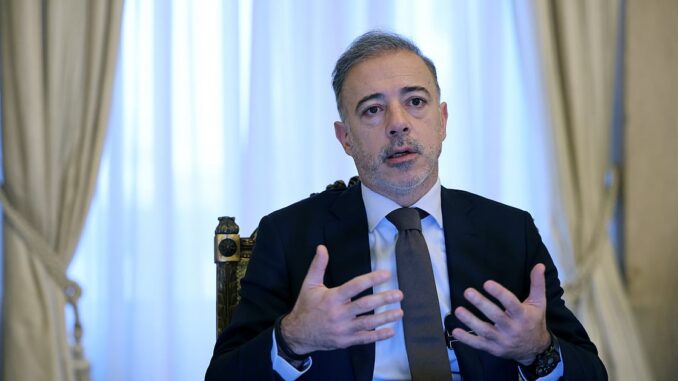
Porto has Government approval for heavy goods vehicles to leave VCI when CREP is deported, and wants to limit car traffic in the center “in an orderly and gradual manner”, the mayor told Lusa.
In an interview with Lusa regarding the 100 days in office that will be marked on Friday, February 13, Pedro Duarte said that the Metropolitan Area’s proposal to prohibit heavy goods on the Via de Cintura Interna (VCI) at the same time as they are exempt from tolls on the Circular Regional Exterior do Porto (CREP/A41) had “an affirmative response from the Government” in the sense of “agreeing”.
However, “from a technical point of view, it is still possible to understand when it will be implemented”, pointing to March, the month in which the exemption from tolls for heavy vehicles on the CREP during rush hours was already scheduled to come into effect, something announced by the Government in November.
In the interview with Lusa, Pedro Duarte also said that he wants to limit car traffic in the city center, but “in an orderly and gradual manner”, to “test it and for people to get used to it”.
“In the short term we will start now, and the first case will be Praça da Batalha, which on some days of the week – we will start perhaps on weekends – we will start limiting car traffic”, said Pedro Duarte.
According to the mayor elected by the PSD/CDS-PP/IL coalition, the change will be phased so that from a “cultural point of view, people become accustomed to a new way of living in the city”, whose “quality of life” is affected by traffic after “consecutive decades in which (…) the use of an individual car was encouraged”.
Stressing that he has no illusions and that the traffic problem will only be resolved in the medium term, “this does not mean that there are no measures that need to be taken in the short term”, stated the mayor, citing one of his electoral ‘flags’, free public transport, which are “a sign (…) to change from an almost cultural point of view, what is an approach that people have to mobility within the city”.
Asked whether, despite the intentions of the policy measure, free buses do not run the risk of being stuck in traffic, Pedro Duarte wants to “increase very intensively” the bus corridors “in the short term”, with the executive mapping the city to understand where they can be placed.
“Wherever we can, we will place it. The idea is, in fact, to invest a lot in this”, he guaranteed.
The president of the Porto Metropolitan Area (AMP) also recalled that “many cars in the city belong to citizens who come from outside the city of Porto” and are not covered by free transport and, after this policy is implemented, mitigating measures could be adopted for those coming from outside, something to “work with neighboring municipalities”.
Asked whether the Chamber’s objective of reducing cars in the center does not conflict with the existence of several parking lots that encourage their use, the Social Democrat acknowledged that “yes, in a certain sense”, but “it is also necessary [haver] parks in the center, especially because there are residents, sometimes, who do not have [lugar] nowadays”, intending to grant them places in underground parks.
He also spoke of the need to create “parks on the outskirts of the center” so that “those who need to bring an individual car can leave the car and then travel around the city either by foot, or by bicycle, or by public transport”.
“We would like to limit surface parking as much as possible, because it is space that is being stolen from people”, he told Lusa, but “from a practical and concrete point of view”, it is necessary to “evaluate where this can be done”.
Regarding the majority of parks not currently being concessioned to private parties and being managed by STCP Serviços, the majority of whose capital belongs to Porto City Council, Pedro Duarte said that he will “do the math from the point of view of efficiency and understand what is the best solution for managing public money”.
However, “if the Council thinks that in a certain location the car park should serve the residents in order to intervene in the public area or public space”, the municipality “cannot do without this capacity”, recognizing that “there is a tendency for the Council itself to perhaps internalize this management” and, “even if there is a concession, the contract can even provide for all of this”.
Regarding new investments in the Porto Metro, Pedro Duarte ruled out that the Campo Alegre and Circular lines, recently mentioned by the transport company’s president, will go ahead of investments such as the São Mamede or Maia II lines, which do not yet have financing secured, or Gondomar – which already has -, as they “will also greatly benefit” Porto, fulfilling the objective of having “fewer cars entering the city”.
Leave a Reply