
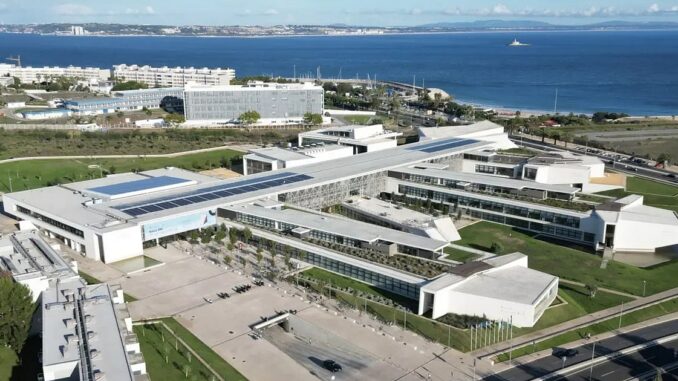
Pedro Santa Clara argues that Nova SBE should “make every effort to leave the Universidade Nova de Lisboa and transform itself into an Independent University Institute”, he tells DN. Reacting to rector Paulo Pereira’s order — which he classifies as a “gratuitous, hostile act that causes profound damage to the school and its brand” — the professor maintains that separation is the only way to protect the investment of 54 million euros made in the Carcavelos campus.
At issue is the decree of the new rector Paulo Pereira, which determines the obligation for the faculties and institutes that make up the Universidade Nova de Lisboa to primarily use their names in Portuguese in all official and internal communications. According to the order, the exclusive use of names in English — as is the case with Nova School of Business and Economics (SBE) — is now restricted to strictly international contexts, a decision that aims, according to the Rectory, to enhance the national language in public Higher Education, but which for critics represents a setback of decades in the internationalization strategy of organic units.
For Santa Clara, this imposition is proof that Nova SBE must follow its own path, claiming that the college has “scale, financial means and a very strong international brand” which make it independent of a structure that, in his view, “has weaker quality” and “less projection”. In his view, the current connection with the university “does not add, reduce, subtract”, which turns the departure into a “divorce that leaves both parties better”, allowing the school to free itself from what it considers to be an obstacle that “pulls the school down”.
The shadow of politics and “envy”
For the mentor from the Carcavelos campus, the decision to impose the use of the name in Portuguese is not a merely administrative issue, but an ideological one. Santa Clara points out that “We have a rector who was elected by a general council of the university and is controlled by some sectors of the extreme left, the Faculty of Human Social Sciences and others at the university”.
In his view, the current scenario results from a convergence of interests against the success of the school. “Whether for political reasons or for reasons of envy, they want to summarize Nova SBE”, states the professor, classifying the measure as a “whim” of a rector who seeks a “manifestation of strength” without any underlying strategic reason.
The professor emphasizes that the success of the economics faculty — which this year it received 1600 international students and maintains two master’s degrees at the top of the Financial Times — is seen with discomfort in the corridors of the rectory. “This is obviously a thorn in the side of some of the university’s professors. And who, now having taken control of the rectory, think they can harm Nova SBE in an unnecessary, absurd way”, he argues.
Santa Clara also reinforces the abyss that separates the Carcavelos school from the institution’s other organizational units. “Nova SBE is a unique case in Portugal. There is no other college with the international projection that it has. There is certainly no other faculty within the Universidade Nova de Lisboa that is even remotely similar”, he concludes.
The value of branding and the global market
Defending the name Nova School of Business and Economics is based on a strategy consolidated two decades ago. “This name came into use 20 years ago. This is not a current issue”, recalls Santa Clara, highlighting that “a very large investment was made in a brand, a campus and an entire international strategy”. For the professor, “Portugal was not at all an obvious destination for a foreigner to come and study” and a school with a Portuguese name “a prioriis not inviting.”
The professor disputes comparisons with institutions such as the Sorbonne or the ETH in Zurich, arguing that the German brand is known by its acronym because its name “is unpronounceable for anyone who does not know how to speak German”. Defending the path taken, Santa Clara is adamant: “The question that arises now is: should it be reversed? This is what has an absurd cost. Someone from outside cannot come and just because, say that we are going to ruin the entire path that has been taken”.
A commitment of 54 million euros
One of the points of greatest tension is the financing of the Campus of Carcavelos, which cost 54 million euros supported by companies, foundations and private donors. Santa Clara emphasizes that the rector’s order represents “breaking a commitment to students, former students and the people who financed” the project, remembering that “the State did not make this investment.”
For the mentor of campusthe decision ignores the practical reality of marketing institutional in favor of subjective opinions. “There are a thousand and one people who have opinions about names is a common thing in marketing. Everyone has an opinion about everything”he states, reinforcing that the school’s strategy should not be determined by “the whim of a rector who has just taken office”.
A thorn in the side of the Rectory
Santa Clara’s conclusion is that coexistence has become unsustainable. “SBE should be consistent and leave Universidade Nova de Lisboa. I think we are both better off. It’s a divorce that leaves both parties better off”, he argues. In his view, the college today has “scale, financial means, relationships with companies and a very strong international brand”, having all the conditions to become an Independent University Institute.
The professor does not hide his dismay at seeing this conflict emerge in the institution to which he dedicated much of his career: “I’m someone who has been very involved with the school for many years, I’m a former student, I really like the school and I really don’t like watching something like this happen in front of me.” For Santa Clara, the separation is the logical step in the face of a rectory that “does not add, reduce, subtract” from the value of Nova SBE.
Rectory responds with “legal obligation” and defends “mutual appreciation”
In response to the criticism, the Rectory of Universidade Nova de Lisboa expressed, in a statement sent to DN, “strangeness” at Pedro Santa Clara’s public statements, highlighting that the topic was never addressed by the directors of the faculties targeted, “directly or indirectly”. For the institution led by Paulo Pereira, the order is not a “whim”, but rather “strict compliance with a legal obligation applicable to public Higher Education institutions”.
The rectory clarifies that the decision follows a direct recommendation from the General Inspectorate of Education and Science (IGEC) and a request for clarification from the Public Prosecutor’s Office regarding the adoption of the designation in Portuguese. According to the statement, the guiding order was previously discussed in the College of Directors and is guided, the institution guarantees, by “institutional rigor and respect for the current legal framework”.
Contrary to the idea that the connection with the university harms the school of economics, Nova emphasizes that integration constitutes a “factor of mutual appreciation”. Although it recognizes Nova SBE as a “faculty of reference”, the rectory reinforces that its success is also associated with belonging to a “strong brand, inserted in international academic networks of great relevance”, thus rejecting the scenario of a “divorce” that Pedro Santa Clara considers inevitable.
Article updated at 6:52 pm with the response from the rectory of Universidade Nova de Lisboa
PROFILE: WHO IS PEDRO SANTA CLARA
Pedro Santa Clara is a full professor at Universidade Nova de Lisboa and one of the most influential figures in the recent trajectory of Nova School of Business and Economics. A former student of the institution, he played a decisive role in the expansion and internationalization of the school, having been the mentor and main driver of the new Carcavelos campus, financed entirely by private funds. Currently, the professor focuses his work on the educational projects Escola 42 and Tumo in Portugal, remaining in academia without holding executive or management positions in the university structure.
Leave a Reply