
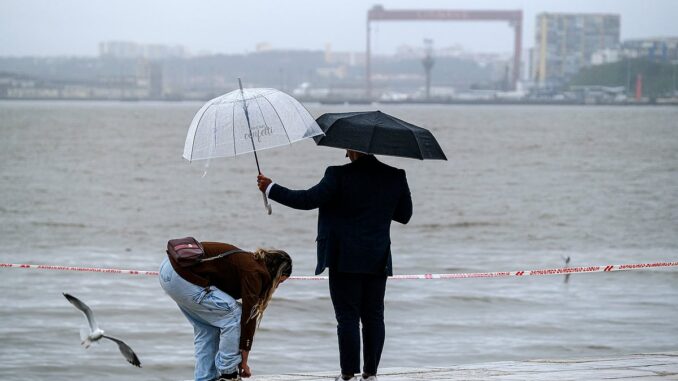
Viseu, Porto, Vila Real, Viana do Castelo, Aveiro and Braga will be under orange warning this Tuesday, February 10th, due to “persistent and sometimes heavy” rain, according to the Portuguese Institute of the Sea and Atmosphere (IPMA).
This warning is valid between 06:00 and 18:00 and these districts go into yellow warning from 00:00 on Tuesday.
During the same period (06:00 and 18:00) Bragança, Guarda, Setúbal, Santarém, Leiria (from 03:00 on Tuesday), Castelo Branco and Coimbra (from 03:00 on Tuesday) will be under yellow warning, according to the most recent IPMA statement.
On Wednesday, until 18:00, Bragança, Viseu, Porto, Guarda, Vila Real, Setúbal, Santarém, Viana do Castelo, Lisbon, Leiria, Castelo Branco, Aveiro, Coimbra, Portalegre and Braga are under yellow rain warning.
Porto, Viana do Castelo, Aveiro, Coimbra and Braga will be under an orange warning of sea unrest between 3pm on Wednesday and 3pm on Thursday, due to “northwest waves with a significant height of 5 to 6 meters, which can reach a maximum height of 11 meters”. These districts will be placed under yellow warning until 7pm on Thursday.
Beja, Leiria, Lisbon, Setúbal and Faro will be under yellow warning of maritime unrest until 7pm on Thursday.
Bragança, Viseu, Porto, Guarda, Vila Real, Viana do Castelo, Castelo Branco and Braga will be under yellow wind warning from 12:00 on Wednesday and 21:00 on Thursday, according to IPMA.
Persistent rain will continue to hit the continent over the next few days, especially in the North and Center, areas where there is already an excess accumulation of water due to bad weather, meteorologist Alexandra Fonseca told Lusa.
Depression Marta has already left Portuguese territory and moved east, but the continent’s territory continues to be influenced by other depressions that are forming further north in the Atlantic and will also be crossed by frontal swells that are associated with these depressions, explained the meteorologist from the Portuguese Institute of the Sea and Atmosphere (IPMA).
Leave a Reply