
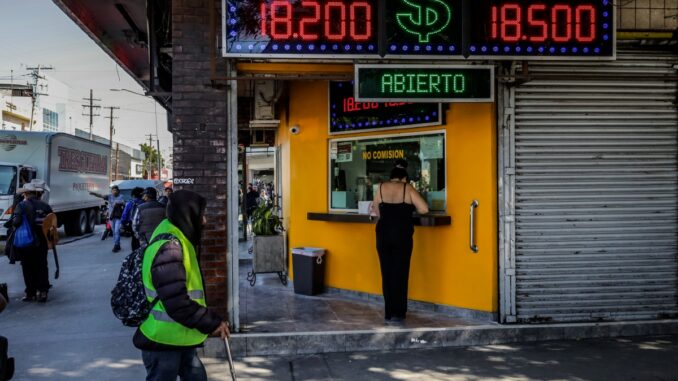
MIAMI (EFE).— The depreciation of the dollar to its lowest level in four years and the increase in unemployment in the United States have begun to directly impact the remittances received by millions of families in Latin America, with a particularly visible effect in Mexico during 2025.
The country registered an annual drop of 4.6% in the sending of remittances, which totaled 61,791 million dollars, according to figures from the Bank of Mexico (Banxico), which put an end to eleven consecutive years of growth in these flows.
The decline occurred in the first year of Donald Trump’s second presidency in the United States and contrasts with the trend observed in other countries in the region, where remittances maintained an upward trajectory.
A report from the Inter-American Dialogue estimated that shipments grew 8% and reached 158 billion dollars in nine countries that concentrate more than 90% of remittances in Latin America and the Caribbean, including Colombia, Guatemala, El Salvador and the Dominican Republic, with Mexico as the main exception.
Despite this regional increase, specialists warn that the depreciation of the dollar has reduced the real purchasing power of recipient families, since the US currency lost around 10% of its value in 2025, its worst performance since 2017.
Economist Alejandra Castillo, global advisor to the Public Spend Forum (PSF), pointed out that the weakness of the dollar reflects a “not very healthy” economic outlook in the United States, with repercussions throughout the hemisphere. “That dollar is no longer yielding the same for families that depend on remittances,” said Castillo, who was assistant secretary for Economic Development of the United States Department of Commerce between 2021 and 2024.
Trump administration officials have defended a weak dollar as a mechanism to boost exports, although the specialist described it as a “double-edged sword” due to its impact on inflation and domestic consumption.
He explained that, although exports are becoming cheaper, imports are becoming more expensive, which puts pressure on prices and adds uncertainty to an economy that currently shows signs of slowdown.
Added to this scenario is the deterioration of the US labor market. The unemployment rate closed 2025 at 4.4%, one of its highest levels since 2021, while layoffs exceeded 100,000 in January, according to consulting firm Gray & Christmas. “When employment in the US slows down, remittances fall sharply, affecting local consumption and tax revenues in recipient countries,” warned Nur Cristiani, head of Investment Strategy for Latin America at JP Morgan.
In Mexico, remittances represent about 4% of the gross domestic product, a proportion similar to that of Colombia, although in countries such as Honduras, Nicaragua and El Salvador they are equivalent to almost a quarter of their economy, according to financial estimates.
The impact could deepen with the entry into force, in January, of a 1% tax on remittances in the United States, a measure that, according to the Center for Global Development, could reduce the volume of remittances by around 1.6% for each additional percentage point of tax.
Leave a Reply