
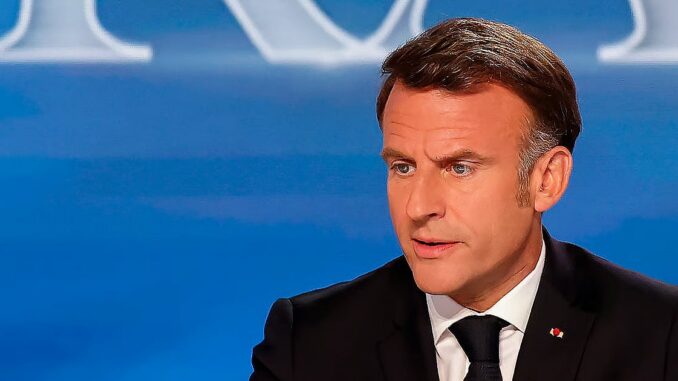
French President Emmanuel Macron defended the use of a new joint loan from the 27 member states of the European Union (EU), which would finance strategic investments and allow the EU to “challenge the hegemony of the dollar”.
“The time has come for the European Union to launch a common debt capacity, through eurobonds”, said Macron in an interview published today by seven European newspapers, including Le Monde, The Economist and Süddeutsche Zeitung, two days before an informal meeting of EU heads of state and government focused on how to boost European competitiveness.
The aim of this joint debt issuance would be to jointly invest in the ecological transition, artificial intelligence and quantum technology, so that the EU does not fall behind in these sectors.
In the interview, which took place this Monday at the Élysée Palace, in Paris, Macron bet on creating a common debt capacity for these future expenses: “eurobonds with a vision of the future”, he highlighted.
“This is a unique opportunity, which would also allow us to challenge the hegemony of the dollar. In fact, the global market is increasingly afraid of the US dollar. It is looking for alternatives. Let us offer it European debt”, proposed Macron, for whom it would be “a serious mistake not to take advantage of this debt capacity”.
Macron also urged not to succumb to a “cowardly sense of relief” in the Greenland crisis, which the North American President wants to conquer, because the reduction in tension, in his opinion, will be short-lived.
In this context, for the French President, the time has come for a European “awakening” in the economic, financial, defense and security, and democratic domains.
And it is necessary to start, he said, with the simplification and deepening of the internal market, and continue with regime 28 (which aims to create a European code of commercial law), the union of capital markets and the integration of our electrical networks because, he indicated, “the native market for our companies cannot be twenty-seven different markets, but 450 million people”.
The second pillar, he continued, is diversification, the signing of new commercial alliances, as the EU has just done with India, as this strategy offers a new source of growth and also allows for the reduction of dependencies, he said.
Asked about the trade agreement with Mercosur, which France opposes in its current state, Macron stated that it is “a bad deal”, that it is “outdated” and was “poorly negotiated”.
“In any case, Mercosur will not have the drastic impact on our agriculture that some fear, nor the positive impact on our growth that others imagine,” he added.
Finally, the French head of state defended the protection of EU industry and the non-imposition of standards on European producers that are not required of non-European importers.
In the field of European industrial partnerships, Macron defended the future European combat aircraft (SCAF) project as “a good project”, and argued that “things must move forward”, despite tensions between the French and Germans.
“It’s a good project and I haven’t had any indication from the German side that it’s not a good project. When industrialists try to create dissent, it’s one thing, but it’s not up to us to support them,” he said, guaranteeing that he would discuss the matter again with the German Chancellor, Friedrich Merz.
Leave a Reply