
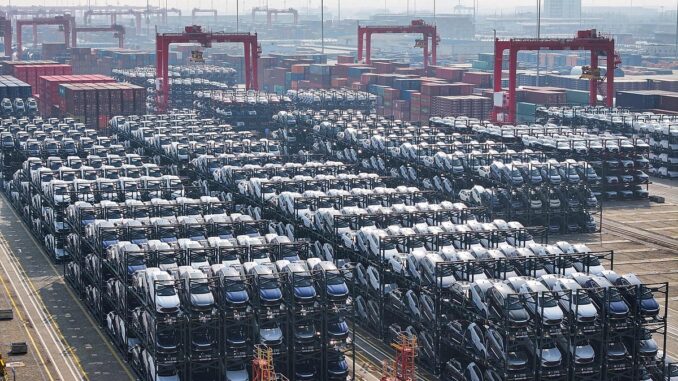
China overtook Argentina in January to become the largest exporter of automobiles to Brazil, consolidating the dominance of Chinese brands in South America’s largest automobile market, according to data released by industry sources.
According to the specialized platform Autoweb, China exported 16,800 vehicles to Brazil in January, compared to 13,400 units from Argentina. This is a historic reversal in the automobile balance between the two main Mercosur partners, which has been taking shape since the first quarter of 2024.
Unlike Argentine cars, which generally include a high percentage of parts produced in Brazil, Chinese cars arrive fully assembled, bypassing the local supply chain.
In value, car imports from China to Brazil reached 375 million dollars (around 315 million euros) in January – more than ten times the value recorded in the same month of the previous year – and represented around 65% of total imports in the sector.
This pattern follows the global strategy of Chinese brands, which begin their presence through exports and, subsequently, invest in local assembly and production units. In Brazil, manufacturers Great Wall Motors and BYD have led this process. BYD invested 5.5 billion reais (around 890 million euros) in the conversion of the former Ford factory in Camaçari, in the state of Bahia, where it intends to produce vehicles based on the “semi-knocked down” model – in which cars arrive almost ready from China and are finished locally, mostly with imported parts.
The practice has generated criticism from the national association of vehicle manufacturers (Anfavea), which warns of the lower generation of employment in local value chains compared to the traditional model of complete production. The president of Anfavea, Igor Calvet, recently praised the Brazilian Government’s decision not to renew the tax exemption for the import of disassembled kits, a measure that expired in January and aims to encourage more sophisticated national production.
According to data from Anfavea, Brazilian automobile production fell 12% in January compared to the same month in 2025, while sales recorded a slight decline. The market share of electrified vehicles reached an all-time high of 16.8%, although only around 35% of these were produced in Brazil. Exports fell 18%, mainly affected by lower Argentine demand.
Despite the strong expansion of Chinese brands in the Brazilian market, Brazil occupies only fifth place among the main destinations for Chinese automobile exports, behind Mexico, Russia, the United Kingdom and the United Arab Emirates. According to the Chinese Passenger Car Association, China exported 8.32 million vehicles in 2025, an increase of 30% compared to the previous year, confirming the sector’s global growth trend.
Leave a Reply