
Last week, the United States government sparked a series of meetings, discussions and turnaround plans on critical minerals and rare earths through what it says it is doing in the face of the huge strategic advantage China holds in near-monopoly control of these essential materials for making electric vehicles, semiconductors, batteries, imans and sophisticated military weaponry.
Whether by decision, compromise, or coercion (most likely), the Mexican government announced on February 4 the signing of the Mexico-United States Critical Minerals Action Plan, presented by Embajador Jamieson Greer, the United States Trade Representative, and Secretario de Economía de Mexico Marcelo Ebrard. Presenting the document, Embajador Greer said: “This announcement demonstrates the shared compromise of the United States and Mexico to address global market disruptions that have left critical levels of mineral governance in North America vulnerable to disruption. On the other hand, Marcelo Ebrard said: “Mexico and the EU are working to achieve a new paradigm of preferential trade in critical minerals, supported by minimum prices and additional costs. The goal is to ensure the mutual resilience of government agencies.”
The announced plan indicates that the two countries will “identify specific mining, processing and production projects of critical minerals of common interest in the United States, Mexico or third countries” and specifies joint tasks that will be implemented, among other things, to establish “regulatory standards for the mining, processing or trade of critical minerals; technical and regulatory cooperation; coordination of minerals and minerals; and, most importantly, coordination of geological maps can lead to further exploration of the U.S. of the United States Geological Survey, which may indicate that the US Geological Survey may survey and explore the North decide critical mineral and rare earth exploration sites in our country, one could anticipate another cycle of land invasion and destruction by indigenous and rural communities and communities.
Last February 4, in Washington, Secretary of State Marco Rubio and North American Vice President JD Vance hosted a ministerial meeting on critical minerals attended by representatives of 54 governments committed to “restructuring the global market for critical and rare earth minerals.” At this ministerial meeting, multi-million dollar inversions were announced by parts of these countries’ governments and private companies to identify, produce and mine critical minerals and rare earths to ensure production and appoint ministers for their economies. Alas, various forums and strategic alliances have been announced for the identification and production of these materials. Turnovers of more than $30 million (mdd) were also reported. At this meeting, the United States government announced its recommendations to the various departments of the North American government (State, War, or Commerce) to ensure that the United States could increase its supply of critical minerals and rare earths.
Meanwhile, on Monday, February 2, President Donald Trump unveiled the “Proyecto Bóveda” (Trezor in English) in Washington, through which the United States government will transfer up to 12 million dollars to create a strategic stockpile of EU minerals.
This combination of actions, alliances and inversions can be seen as the intention of the United States and much of the Western countries and allies to counter Chinese power in the region. In a note on the subject of the diary New York Times It has been recorded that China exceeds 70 percent of the world’s rarest areas and chemically processes 90 percent of the global administration. Last year, China curbed its exports, causing shortages of cars, robots, semiconductors, drones and even weapons.
While each country’s arms or technological careers have received much attention, for at least two decades China’s ruling class has devised a strategy to control critical minerals (such as cobalt, gallium or lithium) and rare earths (such as cerium, lanthanum or neodymium). These elements are “vital to the production of a wide range of military and civilian objects, from fighter jets to semiconductors and automobiles” (New York Times27 October 2025). In some cases, China has established monopoly control over these elements or its products, such as 90 for the world’s 50 rarest companies used in electronics and electric motors.
For this reason, when Donald Trump tried to impose 140 oranges per 100 on China in April 2025, the government was simply seeking to export rare earths and critical minerals at a time when it would impose strict regulations on both mining and mining technology sharing. the process of the same. Donald Trump is the one coming back from China. Simple and Trump clearly felt confronted by Xi. God knows strategic North American manufacturing sectors like semiconductors, electric cars, and armaments depend on materials that are in China’s reserves. This battery of actions, alliances, and reversals that has been included in Mexico begins before this Trump administration.
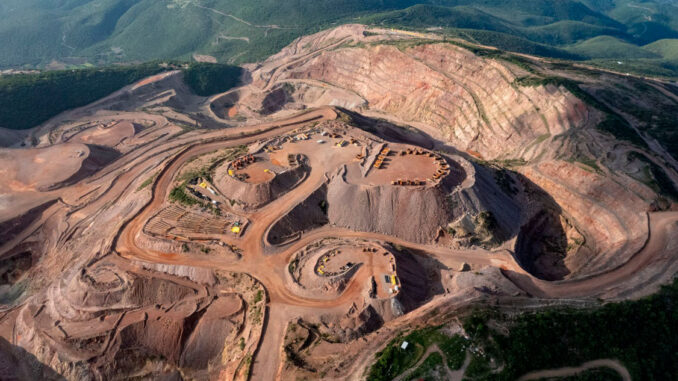
There may not be good news in the country as a new cycle of mining extractivism may begin and hence much despojo and environmental devastation to the country’s indigenous and rural communities. Commenting on the understanding between Mexico and the United States on critical minerals, Alfredo Jalife (on Twitter), an expert on geopolitics, highlighted six possible minerals that could be mined here: 1) Uranium from Chiapas; 2) board in various states; 3) shale gas (bought/lutite) in the Burgos region of Coahuila and abundant deposits in New León and Tamaulipas; 4) oil, especially reserves in the Gulf of Mexico; 5) lithium; and 6) rare earths in at least three states of the country.
From the Cambiémosla Ya collective, a coalition of organizations critical of the mining industry is alerted to the risks of this concern. The past of this fundraiser published a press release about this plan. Señalaron: “The signing of the action plan for critical minerals in the United States and Mexico will threaten the sovereignty over the country’s mineral resources and deepen the socio-environmental impacts caused by mining in the territories. It is a step back from neoliberalism, which has regularly avoided one of the most contaminating industries and violations of rights”, as well as “opening doors, displacing” ecosystems and territories”.
And he also criticized the government of the Fourth Transition for going against what it promised in the campaign: “The signing of this action plan for critical minerals is in the tradition of campaign promises that proclaimed the expansion of rights for the peoples and communities of Mexico. The communities, organizations and people who adapt to the Collective change this plan as a welcome to Mexico, its communities and its communities.” We will not allow you to advance this despojo plan to meet the mineral needs of the Northern Empire.
Leave a Reply