
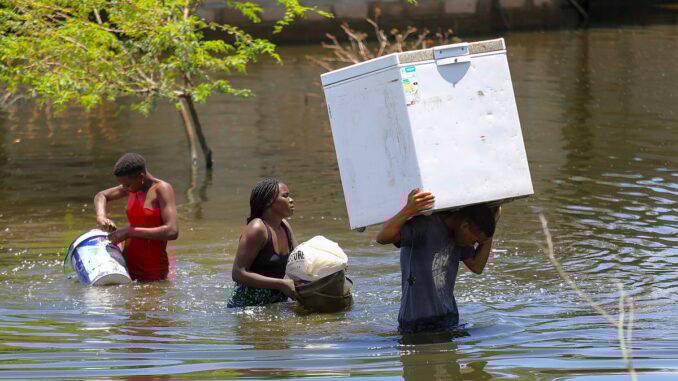
A situation “much worse” than previous floods, recalls the transporter, and then laments: “the people who died”. Meanwhile, there are few passengers waiting to be taken to the neighboring district of Guijá, also in Gaza, along a road covered by water.
Before, the price of the service was 100 meticais (13.30 euros), for a few kilometers, after the floods it is now 150 meticais (two euros) and continues to rise. “The fuel is very hard, there is nothing at the pumps. When you buy a liter it is 300 meticais [quatro euros]”, shoot.
Health centers, hospitals, public buildings, as well as thousands of homes, nothing escaped the floods in Chókwè, including 84 schoolswith no plans for the resumption of normal activities, some used as shelter centers, around two weeks before the start of the school year, postponed a month, due to the floods, to February 27th.
“They house 63 thousand students”, explains the administrator of Chókwè, regarding the impacts of the affected schools, adding: “As our school year will start at the end of this month, we have this safe space in February to carry out the survey and seek this support from our partners in the area of education for we can see that immediate solutions can be guaranteed so that we can return to that period.”
And even the teachers do not know where they are, among the displaced: “We are doing the survey, where they are, because not everyone is in the same center and not everyone is in the center close to where their school is, because their school was affected”. This is the case of Apolinário Basílio, a 40-year-old math teacher, devastated by what he sees in the city, the district’s headquarters. “It’s the country’s breadbasket, but people are crying right now (…), they’re asking for support”he tells Lusa.
“There was a lot of destruction in the city. Here in the first neighborhood, they didn’t leave with anything, they lost a lot of things, there was death”, describes, assuming that the population “needs help”. “The most important priority is food,” he says, lamenting that groups are entering flooded houses to take what little is left.
“The owner of the house is not [deslocados]they vandalize, they steal things. It’s not correct”, he says. Professor Basílio knows that the school is on the other side, but the waters of the Limpopo have destroyed the road, so he doesn’t know if he will be able to get work on February 27, the scheduled start date for the school year in 2026. “There is no connection”, he says, pointing to the other side of a road that only a few try to cross, on foot, such is the force of the water.
Administrator Narciso Nhamuco recognizes the difficulties and admits that only the city of Chókwè, in the lower zone, “suffered a lot”, with access cut off to the north and a large part of the 139 thousand inhabitants in displacement centers. “The majority of this population, in almost all neighborhoods of Chókwè, were flooded and suffered”he admits, recognizing that “a large part of the infrastructure suffered”, whether from the State, houses or roads.
“But a fundamental element of great concern is the issue of irrigation, because irrigation surrounds the city and the entire district and is the basis of the livelihood of our population. This is the biggest problem. And the access roads. And, as you know, this will also worsen the drainage situation”, he says. For now, in the breadbasket of Mozambique, the fear about the coming months is hunger, while the water slowly disappears.
Leave a Reply