
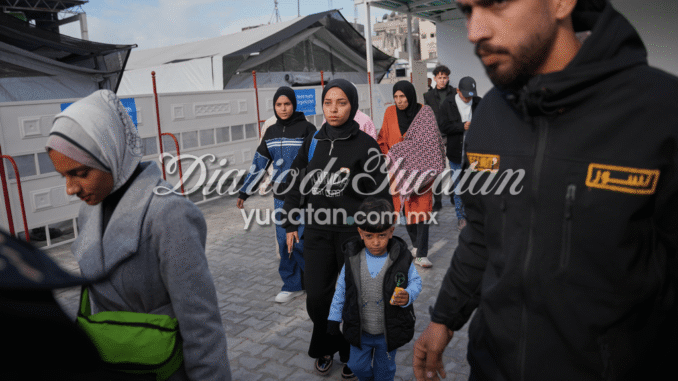
The Rafah crossing between Gaza and Egypt, reopened on February 2, has been closed for two days
KHAN YUNIS, Gaza Strip, February 7, 2026 (AP).— When the Rafah border crossing between Gaza y Egypt finally reopened this week, Palestinian officials proclaimed it as a “window of hope” after two years of warwhile a fragile agreement of cease fire keep it up.
But that hope is hampered by disagreements over who should be allowed through, delays of several hours and reports from Palestinian travelers who say Israeli soldiers handcuffed and interrogated them.
Far fewer people than expected have already crossed in both directions.
Restrictions negotiated by Israeli, Egyptian, Palestinian and international officials meant that only 50 people could return to Gaza a day and 50 medical patients, along with two companions for each, could leave.
However, during the first four days only 36 Palestinians who required medical attention They were able to leave for Egypt, in addition to 62 companionss, according to data from the United Nations.
Palestinian officials say Nearly 20,000 people in Gaza seek to leave to receive medical attention which, according to them, is not available in the territory devastated by the war.
Rafah crossing between Gaza and Egypt closed
Amid the confusion over the reopening, it was reported that the Rafah crossing was closed yesterday Friday and today Saturday.
He Rafah crossing it’s a line vital for Gazasince it provides the only link with the outside world which is not controlled by Israela country that took it in May 2024, although traffic through the crossing was severely limited even before that.
Several women who managed to return to Gaza after the reopening of Rafah crossing They told AP the harsh treatment by Israeli authorities and an Israeli-backed Palestinian armed group, Abu Shabab.
A mission of the European Union and Palestinian officials manage the border crossing, and Israel It has a control facility at some distance.
Eager to return two years after fleeing to Egypt with his wounded sister, Rana al-Louh expressed that Israeli guards They asked him several times why he wanted to return to Gaza during an interrogation that lasted more than six hours.
They accuse Israeli military mistreatment at the Rafah crossing into Gaza
Rana al-Louh declared that Israeli soldiers blindfolded her and handcuffed her, an accusation made by others.
“I told them that I returned to Palestine because my husband and my children are there,” she said. Al-Louh.
The interrogators told him that Gaza belongs to Israel and that “there will be more war if Hamas He doesn’t give up his weapons. “I told them I didn’t care, I wanted to go back.”
Asked about these reports, the Israeli Army responded that “there are no known incidents of inappropriate conduct, mistreatment, arrests or confiscation of property of the Israeli security establishment.”
The intelligence agency Shin Bet y FORCESthe Israeli military body that handles Palestinian civil affairs and coordinates the crossings, did not respond to questions about the allegations.
The long interrogation on Wednesday delayed the return to Gaza of Al-Louh and others until almost 2 am on Thursday.
UN confirms Israel’s military mistreatment of Palestinians
Later that day, UN human rights officials They pointed out a “consistent pattern of mistreatment, abuse and humiliation by Israeli military forces”.
“After two years of total devastation, being able to return to their families and what remains of their homes with safety and dignity is the minimum“, he indicated in a statement Ajith Sunghayhead of human rights at the agency for the occupied Palestinian territories.
The officials who negotiated the reopening of the Rafah crossing They were clear that the first few days would be a pilot. If it was successful, the number of people crossing could increase.
Problems entering or leaving Gaza through the Rafah crossing
Challenges arose quickly. On the first day, Monday, February 2, Israeli officials said they were cleared to leave Gaza 71 patients and companions, and the entry of 46 Palestinians was approved.
inside GazaHowever, the organizers of the World Health Organization (WHO) They were only able to arrange transportation for 12 people that day, so other patients were left behind, according to a person briefed on the operations who spoke on condition of anonymity because they were not authorized to speak to the media.
Israeli officials insisted that Palestinians would not be allowed to enter Gaza until all outputs were complete.
They then said that since only 12 people had left Gazaonly 12 would be able to enter, leaving the rest waiting on the Egyptian side of the border overnight, according to the person briefed on the operations.
The crossings increased on the second day, when 40 people were allowed to leave Gaza and enter 40.
But delays increased when many returning travelers arrived with more luggage than agreed and more prohibited items, including water and other liquids.
Each traveler is allowed to carry a mobile phone and a small amount of money if they submit a declaration 24 hours before travel.
Every time a Palestinian was admitted to Egyptthe Israeli authorities allowed one more entry into Gazawhich prolonged the process.
The problems continued on Wednesday the 4th and Thursday the 5th, with the number of people allowed to cross decreasing. The bus transporting those returning from the crossing on Wednesday arrived at its destination in Gaza at 1:40 a.m. Thursday.
The return to Gaza, “journey of suffering”
Even so, some Palestinians said they were grateful to have made the trip.
While the return of Siham Omran a Gaza lasted until early Thursday, she held firm with thoughts of her children and husband, whom she did not see for 20 months.
“This is a journey of suffering. Being far from home is difficult”he said after arriving at a hospital in Gaza. “Thank God we have returned to our country, our homes and our homeland”.
Leave a Reply