
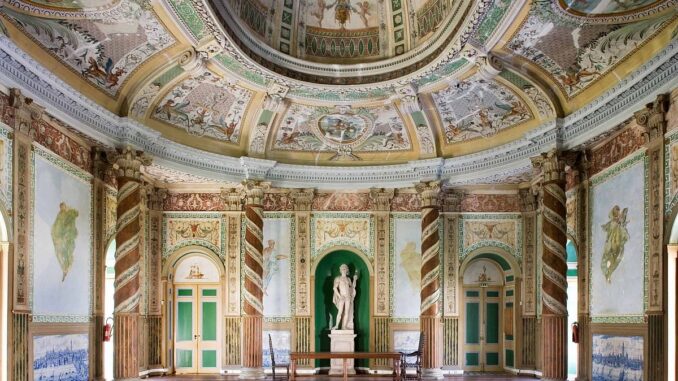
The Overseas Historical Archive (AHU) of Portugal is still consulted today by Brazilians looking for proof that they are the owners of their lands in Brazil, distributed by the Portuguese five centuries ago, according to the person responsible for this institution. “From time to time, we receive requests to hand over an authenticated document to a court, or to settle a dispute or conflict at that level, despite it being historical documentation”Ana Canas, a researcher at the History Center of the University of Lisbon and who has been managing the AHU, told the Lusa agency.
This documentation, physically present in the AHU, but already available on digital media, includes documents from the granting of sesmarias in Brazil, a land distribution system adopted by the Portuguese Crown in the 16th century, in which land was donated to sesmeiros, so that they could occupy them and produce on them. And it is this proof of land concession that its owners still seek at the AHU today, as it is there that the documentation resulting from the relationship between Brazil and the Portuguese administration resides, during the colonial period.
This archive, created in 1931 with the aim of safeguarding the repositories of the Portuguese colonial administration, stores around 17 kilometers of documentation. The records portray the relationship between the various territories (former Portuguese colonies) and the organizations based in Lisbon.
Documents that have proven to be sources of information about these territories and their experiences: India, Brazil, Angola, Cape Verde, Guinea-Bissau, Mozambique, São Tomé and Príncipe, Timor-Leste and Macau. The Brazilian collection, located at the AHU facilities, which is located in the Ega Palace, in Lisbon, was the subject of the Barão do Rio Branco Resgate Project, an international archival cooperation program, whose mission is to catalog and reproduce the handwritten historical documentation relating to this country, until independence, in 1822.
The Portuguese arrived in Brazil in 1500 and the occupation of the lands began in 1530. It is the history of this presence and the relationship with the Crown, in Portugal, until independence, that the documentation tells. For more than 10 years, around 120 researchers involved in this project worked on the 300,000 documents that are at the AHU and that involve Brazilwhich are now properly identified and distributed in more than 2,000 boxes, in addition to being available on digital media.
Strategies of the Portuguese Crown
This is the Kingdom series from the Conselho Ultramarino fund, in which you can see, for example, a letter from the governor of the island of Santa Catarina, in Brazil, to the Portuguese king Dom João V, dated 1748. The document refers to the arrival of couples from the Azores and Madeira, in which women play an important role as colonizers. This was, in fact, a strategy by the Portuguese Crown to populate the vast Brazilian territory and prevent conquest by other peoples.
Brazil’s documents had initially been microfilmed, which was the technology made available in the 90s (20th century), and were subsequently digitized, with the images being accessible through the project itself, based at the National Library of Brazil. The processing of this documentation facilitated its consultation, avoiding long and distant trips, with researchers now being able to easily carry out its study, which has happened.
According to Ana Canas, the processing of this documentation was followed by “an avalanche of research, not only from Portuguese researchers, but a lot from Brazilian researchers”, who until then had to travel to Portugal to consult the documents. And since 2014, when the collection was made available in a more stable manner, numerous theses have been produced, with several Brazilian universities involved in the study of various aspects of Brazil, such as social, economic and political.
Ana Canas has no doubt that This work has allowed Brazil to know itself betterespecially because this documentation, being part of the history of Portugal, is also part of the history of the countries with which Portugal interacted, its memory and its identity.
Leave a Reply