
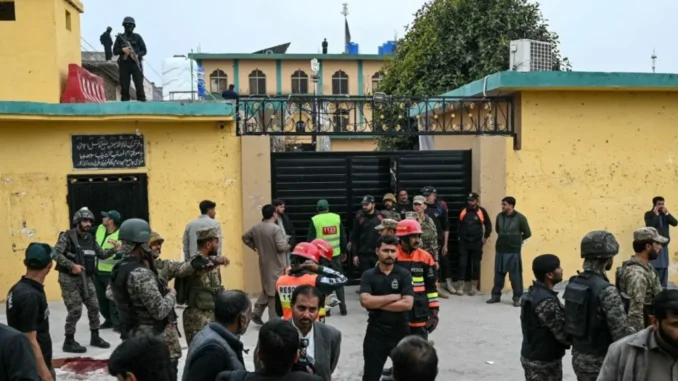
A attack at a Shiite mosque in Islamabad during Friday prayers left at least 31 dead and 169 injured, in the deadliest attack in Pakistan’s capital since the attack on the Marriott hotel in 2008.
The explosion occurred when the country’s mosques were full, said a senior police official on condition of anonymity. The balance “should continue to increase,” he stressed.
Islamabad Municipality says 31 people died in blast at mosque Imaman Bargah Qasr-e-Khadijatul Kubain the Tarlai neighborhood, on the outskirts of the city.
Another security source, who also requested anonymity, indicated that the explosion at the mosque was due to a attack suicidal. “The attacker was stopped at the entrance and blew himself up,” he said.
Journalists testified that dozens of injured people arrived at a large hospital with blood-stained clothes.
Doctors and bystanders helped victims transported in ambulances and at least one arrived in the trunk of a car.
Pakistani Prime Minister Shehbaz Sharif “strongly” condemned the attack, and stated that its perpetrators would be found and brought to justice.
No group has so far claimed responsibility for the attack, which comes as Pakistani security forces fight intensifying insurgencies in the country’s southern and northern provinces, on the border with Afghanistan.
Pakistan is a Sunni-majority country, but Shiites make up between 10 and 15% of the population. They have suffered attacks in the past by jihadist groups.
Michael Kugelman, a South Asia specialist, said in X that the potential perpetrators of the attack are the local branch of the Islamic State group or anti-Shiite militants.
United Nations Secretary General Antonio Guterres said that “attacks against civilians and places of worship are unacceptable,” according to his spokesman.
Strongest attack in 18 years in Pakistan
This attack is the bloodiest recorded in the Pakistani capital since September 2008, when 60 people were killed in a suicide truck bomb attack that destroyed part of the luxury Marriott hotel.
In addition, friends and relatives screamed and cried as the victims, dead or alive, arrived at the hospital’s heavily guarded emergency room.
Another team of journalists from the AFP He saw armed security forces outside the mosque, where pools of blood were visible.
Yellow police tape surrounded the area where shoes, clothing and broken glass lay on the ground.
Insurrections
The government claims that armed separatist groups from Balochistan, the Pakistani Taliban and other Islamist militants from the northern province of Khyber Pakhtunkhwa, near Islamabad, use Afghan territory as a refuge to launch their attacks.
The Afghan Taliban government denied these accusations on several occasions and bilateral relations deteriorated.
Forces from both countries regularly clash along the border.
The attacks triggered a wave of counter-operations in which authorities say security forces killed nearly 200 insurgents.
Leave a Reply