
former Prime Minister of Spain, Jose Luis Rodríguez Zapaterohe is coming to Caracas and accompanying you Delcy Yes Jorge Rodriguez in the context marked by the passing of the project of the general amnesty law in the Venezuelan National Assembly.
Its presence, known from information published in various communication media, coincides with a legislative process that has caused deep concern among human rights organizations and collectives of victims of serious violations of the recent past.
The amnesty law currently under discussion provides legal benefits to those prosecuted for certain crimes from 1999 and later.
Although the Venezuelan government presents this initiative as a tool oriented towards political reconciliation, several specialized organizations have recommended it the guarantee of effective justice, truth, full correction, historical memory and no repetitionbasic principles recognized by international human rights law and transitional justice standards.
What is at stake goes beyond the mere degree of prison release or institutional relaxation.
According to legal analysis and human rights, the actual drafting of the project could dilute responsibility to a clear distinction between crimes of a political nature and crimes that cannot be subject to amnesty under international law, such as crimes of bodily harm or serious and systemic violations of fundamental rights.
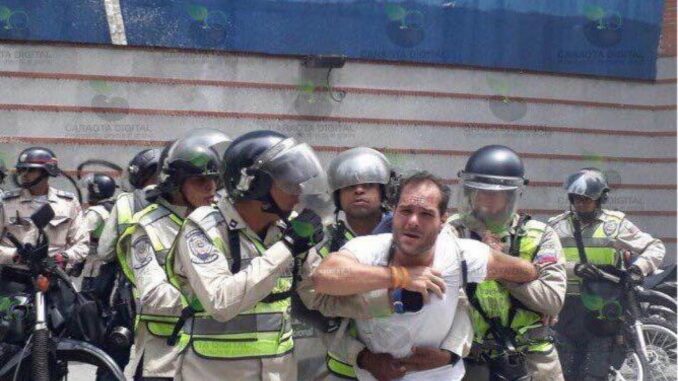
Sergio Contreras, the day of his release.
Parliamentary debate has not yet included robust victim participation mechanisms or extensive consultation processes for those who have been arbitrarily detained, tortured, summarily executed or politically persecuted over the past few decades.
In this context, Rodriguez Zapatero’s visit to Caracas is interpreted by prominent analysts as a political reaction to the process led by the Venezuelan regime.
A process that is never respected and at the same time occurs at a moment of special media exposure and public discussion about Zapater in Spain, through the recent publication of various periodicals concerning controversies and court proceedings that are part of the public debate.

From this perspective, some periodic readings believe that travel could contribute to enhancing the international profile of the mediator, a legitimate interpretation within democratic pluralism.
At the same time, sections of the Venezuelan democratic opposition, victims’ organizations and human rights defenders have expressed criticism and concern about the political use of these media, because they believe that they could contribute to the international legitimization of a legislative process that favors the war policy of the conflict in the interests of the victims’ rights.
These voices underscore the absence of transparent mechanisms to ensure that amnesty does not lead to the elimination of responsibility for serious or systemic crimes.
It is worth noting that in accordance with international jurisprudence and consolidated standards on amnesties, no internal regulation can exclude liability for crimes of bodily injury or serious violations of human rightsthey do not replace genuine processes of transitional justice with old institutional forms.
Amnesties that ignore truth, reparation and guarantees of non-repetition are incompatible with the international obligations of the Venezuelan state, including the derivatives of the Rome State of the International Criminal Court.
As a defender of human rights and victims of human crimes committed by the regime MaduroI reiterate that civil society, victims and international protection mechanisms must be reviewed and taken into account in any process with an impact on the judiciary in the transitional period.
International mediation must not be transformed into a tool that promotes impunity or the extent of historical responsibility, nor in any form of legal self-defense by the perpetrators of crimes when they mock the real victims.
*** Sergio Contreras is a human rights defender and former Venezuelan politician.
Leave a Reply