
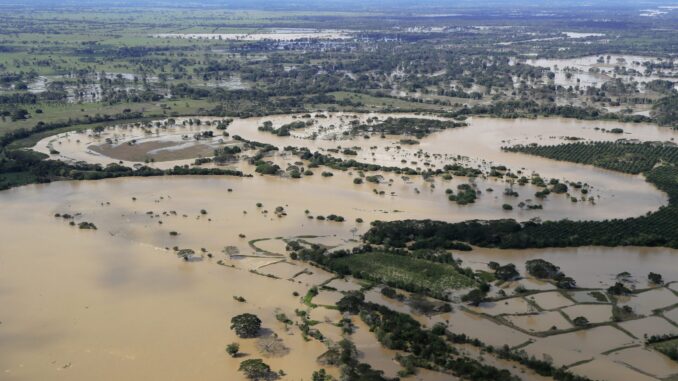
TIERRALTA, Colombia.- “Everything was lost, except life,” he said José Julian Castañofarmer of the black gates villageone of the thousands of victims that left the recent flooding of the Sinú river in the rural area of the municipality of Tierralta, in the Colombian department of Córdoba.
The man says that the emergency came without warning, because the water began to rise and he decided to wait, like other times, to see if the flood would stop, but this time it did not happen because the water ended up entering his house four days ago and reached about a meter high. Thus he lost his chickens, pigs and the crops that supported his family.
“The only thing that was not lost were our lives,” he insisted.
More than 27,000 families are being affected by the winter wave in Colombia.
The rains are putting access to food and the protection of thousands of homes at risk.
Acting on time is key.
👉 Donate now at
https://t.co/yiz0VPr2GX pic.twitter.com/HPyD4s5Ija— Bogotá Food Bank (@BancoAAlimentos) February 6, 2026
The eviction came later, when there was no longer a way to stay in the home, so Castaño and his family, part of a group of 21 people, were transferred to improvised shelters by the Mayor’s Office in schools and churches in the area.
There was no alert
The farmer assured that they did not receive any alert for the eviction: “No, nothing, nothing. There was no alert about anything,” he stated.
And although he recognizes that the Sinú River floods frequently in the area, he says that the fear now is different because “before there were three or four floods a year” and it was known where the water passed.
But now they live with “the fear of that wall falling,” in reference to the dam of the Urrá hydroelectric plantthe only one in the northern part of Colombia, which has four turbines with an installed production capacity of 340 MW.
The reservoir, located 276 kilometers from the mouth of the Sinú River, has an area of 7,988 hectares that stores 1,616 million cubic meters of water.
In this video you can see how a canoe crosses the field, the classrooms, the multiple room, completely submerged in the water at the Nueva Unión Educational Institution, in Tierralta, after the climate emergency in Córdoba. The affected families need help.
We call… pic.twitter.com/G3LdhWrCj2— fecode (@fecode) February 6, 2026
He Urrá landfill, which according to the company also serves to regulate the flow of water, has a maximum discharge capacity of close to 9,000 cubic meters per second that fall into the Sinú riverbed.
That, according to the farmers, worsens downstream an emergency that began with the atypical rains at this time of year in the country, as a result of the arctic cold front that reached the south of the Caribbean.
While the victims wait for answers, the national government and local authorities try to address the emergency.
A state of calamity has been declared in Córdoba department, northern Colombia, after severe flooding affected more than 10,000–13,000 families across at least 17 municipalities.
Authorities say rising levels along the Sinú River have been worsened by emergency management at the… pic.twitter.com/if9tQP1oyU
— Volcaholic 🌋 (@volcaholic1) February 3, 2026
The director of the National Unit for Disaster Risk Management (Ungrd), Carlos Carrillowho a few meters from where Castaño was recounting his tragedy, reported the arrival of a air force flight with more than ten tons of help transferred from Bogota.
As he explained, the assistance includes food, cooking and personal hygiene kits, as well as hammocks and sheets, and their delivery “depends on the registration of the families in the official census of victims carried out by the municipal authorities.”
Thousands of victims

Meanwhile, the mayor of Tierralta, Jesus David Contreraspointed out that the situation “continues to be critical in the rural coastal areas,” and according to the preliminary balance, some 60 villages remain floodedwith more than 5,100 families affected and around 8,000 hectares of crops lost.
Currently, the mayor indicates, they operate 36 temporary shelters in the municipalitywhere communities receive daily food while the waters begin to recede.
For Castaño, however, the concern goes beyond immediate help: “Now what do we do?” he asks.— (With information from Esneyder Negrete).
You might also be interested: “Storm Leonardo hits Spain and Portugal; leaves one dead and a girl missing”
Leave a Reply