
The keys
nuevo
Generated with AI
nuevo
Generated with AI
The indirect conversations between Iran and USA in the capital of OmanMuscat, have finished, with a “will to continue”although both parties have not specified any date to continue negotiating.
“It is a good start,” said Iran’s Foreign Minister, Abbas Araqchí, on his country’s state television after today’s negotiations, which he assured that They have focused on the nuclear issue and have not touched the Persian country’s missile program.
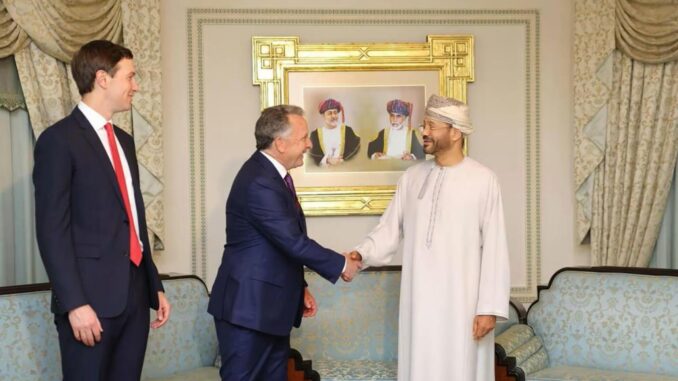
Araqchí affirmed that he has had “long and intense” conversations with the White House special envoy, Steve Witkoff, y Jared Kushner, son-in-law of US President Donald Trump, through the exchange of messages through the Omani foreign minister, Badr bin Hamad al Busaidi, mediator of the negotiations in Muscat.
The Iranian diplomat explained that they have agreed to continue negotiations, but how and when this process will be carried out requires consultations with Tehran and Washington.
Araqchí said that after “eight turbulent months” and the twelve-day war with Israel there is a great “mistrust that is an obstacle in negotiations.”
Despite this, he maintained that “if the United States continues with this approach we can reach the formation of a negotiating framework in the next talks.”
Of course, he established as “a condition for any dialogue is to refrain from threats and pressure.”
These negotiations are heldn under threats from Trump to intervene militarily in Iran, for which it has deployed the aircraft carrier USS Abraham Lincoln and its combat group – made up of three missile destroyers – near Iranian waters in the Persian Gulf.
It is about the first negotiations between both countries since the war between Iran and Israel in Junein which Washington participated with the bombing of Iranian nuclear facilities, which has crippled Iran’s uranium enrichment capacity.
The two parties have come to these conversations very far apart even in what they intend to discuss.
Differences over negotiation
The United States seeks to include in the agenda, In addition to the Iranian nuclear program, the limitation of its ballistic missiles and talk about your support for regional groups of Hamas, Hezbollah and the Houthis in Yemenwhile Tehran wants to negotiate exclusively the limitation of its nuclear programr, something that Araqchí reiterated this Friday.
“The topic of our conversations is only nuclear and we do not discuss anything else with the Americans,” he said.
Both countries held talks last year in Muscat, with Oman as intermediary, but they came to an end after the start of the war between Iran and Israel.
These negotiations take place at one of the lowest moments of the Islamic Republic after experiencing the most violent protests since its founding in 1979, in the midst of a serious economic crisis, strong discontent among the population, its worst drought in decades and shortages of electricity and gas.
The demonstrations began in December due to the fall of the rial, but soon spread throughout the country calling for the end of the Islamic Republic and came to an end in a repression in which Tehran acknowledges 3,117 deaths.
But opposition organizations such as HRANA, based in the United States, place 6,872 deathsalthough it continues verifying more than 11,000 possible deathsas well as 40,000 arrests.
The UN special rapporteur for Iran, Japanese Mai Sato, has told US media that reports from doctors inside Iran indicated that Up to 20,000 deaths could have been recorded due to the repressionalthough according to the United Nations these figures remain difficult to corroborate.
Leave a Reply