
In memory of reporter Rodolfo Guzmán, El Negro,
an admired colleague and a dear, unforgettable friend.
Clara Brugada Molina decided to reopen a narrative as old as it is dangerous: blaming aspects of reality that she could not transform.
I must confess to you that none of this, as was common for years in the newsrooms, where my pinino reporters wrote the infamous red note. He worked there for more than a year Magazine de Policíabi-weekly publication Excelsiorwhich was directed by veteran police reporter Manuel Camín. The content was exclusively remarks about violence and crime, frankly scandalous. Julio Scherer García eliminated her shortly after coming to the general management of the team Excelsior, in 1968.
My experience – which included the brutal shock of first meeting me in front of the corpse of the baleada – was not rewarding, but very formative. It seems to me that political information means a formidable focus for any journalist in the news. It is the most alive and the most recently valuable. I am not aware of the glorification of violence or the Amaryllis scandal, but I will never be a party to the fact that information is hidden, much less for political reasons. They exist, regardless of whether they appear on the television screen or in the pages of a newspaper. Point.
It seems to me because after the publication of the National Public Security Office (ENSU) of the fourth quarter of 2025 on January 23, the representative of the capital responded with an alarming light. Before statistically proving that the myth persists in the capital, the response was not a strategy adjustment, but rather a compromise against the means of communication with the suggestion that the outlet “reduce” the red note so as not to “contaminate” the perception of the citizen.
The blind answer policy has been elevated to the level of government. For Brugada Molina, the fact that 59.5 percent of capitalists admit that they do not feel safe is not the result of actual violence, but of supuesto informative excess. According to your reading, the citizen does not worry about what he lives or what he reads. This position aims to nullify the fire by closing the windows and reveals a clear desperation: faced with the inability to eradicate crime in the streets, the administration has decided to try to manage silence.
Realize that it is not easy to spend living in uncertainty every day of your reign.
Before the criticism that her statement provoked, the representative tried a rhetorical turn, which was confirmed on the spot. Last year, Brugada went to the media to complain that “lies” were being spread and that it proposed a “pact of silence”. However, the semantic text is not intended: although the word “pact” is used, it maintains the requirement that the media must prioritize violent events on its agenda.
Denying what their own lips have indicated will not fix the Head of Government until they dive into denial and accuse people of lying to those who have simply surrendered their right to freedom of information protection.
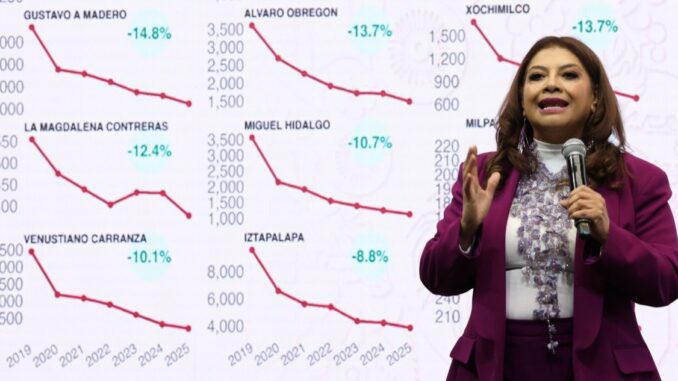
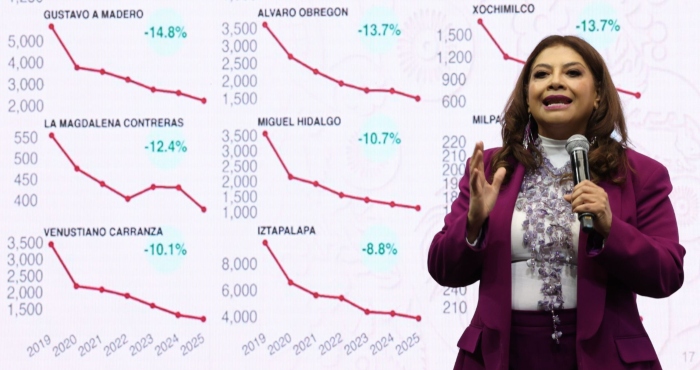
The data from Inegi is of course a mistake that undermines the artificial optimism of the official discourse. While the government of Mexico anticipates a 56 percent reduction compared to 2019, a nationwide survey shows that vulnerability continues to grow. As of 2025, the perception of uncertainty has risen to 59.5 percent, up five percentage points from the 54.2 percent recorded in the third quarter of the same year alone. The gap between “official truth” and “living truth” is closing at an alarming rate.
There is a technical and moral contradiction in Brugada Molina’s discussion that needs to be separated. If these official numbers are so solid, why are citizens’ perceptions moving in the right direction? The reaction is in what the official discourse prefers to ignore: the black figure and the invisible violence that does not make it to the investigative carpets. More than 92 percent of crimes in the capital went unreported, according to the latest National Survey of Victimization and Public Safety Perceptions (ENVIPE). This vast mass of unpunished crimes is what fuels the myth, not even the headlines of periodicals. Extortion, the object in transit and constant storage are realities that shape the daily life of the neighbor.
People are not silent because they are watching television; he keeps the honey because he lives in a city where impunity is the rule and where taxation seems more concerned with political tools than disarticulating the gangs that harbor neighborhoods. Inefficiency in the prosecution of justice is the real driver of social desire.
The territorial contrast in the capital is the best argument against the “media attack” thesis. In Iztapalapa and Gustavo A. Madero, you are each of these residents living in constant fear. Alcaldía Benito Juárez, in turn, maintains itself as a security reference, consolidating quarter after quarter as one of the demarcation borders with the least perception of insecurity in the entire country. Maybe the residents of Benita Juárez don’t have access to the same average things as the residents of Iztapalapa? The difference is not informative, it is about results.
To suggest that the populace feels unsafe just because of the banging of the windows is disrespectful to the intelligence of the capital. It ignores subway muggings, the presence of “halcones” in markets, and criminal territorial control. Asking the media to incite violence is asking the victims to put themselves at their mercy, because the presence of the media is often the only way to ensure that an indifferent authority decides to investigate a femicide or despojo.
Safety is a construction of trust, achieved inch by inch on the street, not in the newsrooms. Reality is not changed by a public relations exercise or the selective release of a daily tragedy. It is being transformed by capable policies, with a tax system that cannot be faulted, and a government that recognizes that the problem is on the street, not in the news. By accusing the man and denying his own words, Brugada avoids the responsibility of the review because his model of safety does not match the feelings of the neighbor.
The red note in Mexico is not the cause of the honey; It is a registry of social ills that the government refuses to care deeply about. The story is not a collective hallucination or a figment of the imagination; it is the echo of a city that is vulnerable. The mirror is not to blame for the reflection, and breaking it will only result in thousands of pedazos to follow, showing the same reality, but now multiplied in silence. Valgame.
DE LA LIBRE-TA
CALLENSE. As for censorship intentions, read on Callense, new censorship registersa book containing the texts of journalists about governmental intentions to promote the truth, compiled by Humberto Musacchio (ed. Grano de Sal). Written by Sergio Sarmiento, Julio Astillero, Héctor de Mauleón, Rafael Cardona, Héctor Aguilar Camín, Yuriria Sierra, Carlos Loret, René Delgado, Francisco Garfias, Ciro Gómez Leyva, Denise Dresser and his own Musacchio, among others. Important and above all current. It’s worth it.
@fopinchetti
Leave a Reply