
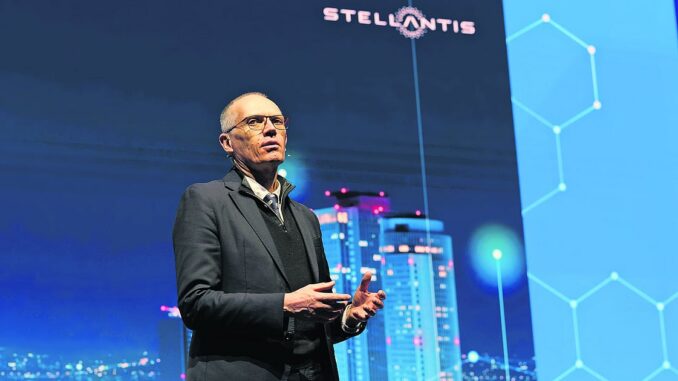
Stellantis — the largest automotive group in the world in terms of number of brands, holding a portfolio of 14 brands that bring together giants such as Fiat, Peugeot, Citroën, Opel, Jeep and Ram — is experiencing its darkest day this Friday (6 February) since the merger that created it in 2021. A financial collapse that confirms the failure of the strategic choices of the former CEO, Portuguese manager Carlos Tavares. According to data from Reuters, the group announced extraordinary costs of 22.2 billion euros, a “bill” that market reality imposed after the collapse of demand for electric vehicles and the loss of ground to Chinese rivals.
The current CEO, Antonio Filosa, categorically admitted: his predecessor’s bets were “too optimistic”, now forcing a “strategic reset” to try to save the company.
With the abrupt drop in shares, the announced impairment is today higher than the company’s total market value, a scenario that Citi analysts describe as “extremely negative”.
The “cost” of “cost-killer“
Carlos Tavares, the executive who for years was nicknamed “cost-killer” (for the cost-cutting management approach he adopted at Nissan or at the Peugeot-Citroën group (PSA) — which he led during the pre-merger with Fiat), was formally fired at the end of 2024 after US sales go into freefall. However, his departure was not without controversy: Tavares left with a global remuneration package that, in its last full year, reached 36.5 million euros. This value, which included performance bonuses and long-term incentives, was strongly contested; At the general meeting, the vote on remuneration was not unanimous, facing opposition from around a third of shareholders and severe criticism from governments and unions, who considered the award immoral given the state of the company.
As Reuters reports this Friday (6), Filosa acknowledged that The construction quality problems that the group’s cars suffer today are a direct result of the obsession with cutting costs. To try to stop the technical degradation, Stellantis was forced to urgently hire 2,000 engineers.
Forced recoil for the combustion engine
One of Tavares’ biggest mistakes was the big bet on “EV-first” (primarily electric) platforms, ignoring the flexibility that the market, in reality, needed. Now, Stellantis is racing against time to create combustion or hybrid versions in models that were not designed to receive them.
This “industrial setback” is proving costly and complex. The most emblematic case is that of the Fiat 500e: Designed to be electric-only, low demand forced the brand to hastily announce a hybrid version, requiring profound changes to the Mirafiori chassis and assembly line. The same happens in the USA with the new Dodge Charger; The STLA Large platform, although billed as multi-power, is undergoing severe last-minute adjustments to accommodate the high-performance combustion engines customers demand, generating delays and development costs not anticipated in Tavares’ original plan.
Stellantis vs. the giants of the sector
Stellantis’ dark situation becomes even more glaring when compared to its main rivals, highlighting how the group has fallen behind in managing the energy transition.
While Tavares pushed for a target of 100% electric in Europe by 2030, Toyota maintained a “multi-path” strategy, focusing heavily on hybrids. The result is evident today: Stellantis announces record losses and Toyota continues to post solid profits, proving that flexibility was indeed the safest path.
The German giant Volkswagen Group it also faces crises and factory closures, but its market capitalization and global sales structure are much more resilient. VW began a course correction process a long time ago, avoiding the sudden inventory collapse that Stellantis suffered in the US.
As for the “new” BYD and Teslathe technological advancement of Chinese rivals and Elon Musk’s brand exposed Stellantis’ cost inefficiency. Tavares tried to compete by cutting production costs, but BYD is able to produce high-quality electric vehicles at a fraction of the cost, without compromising engineering as happened in the European group.
At the moment, Stellantis’ market capitalization has fallen to such low levels that the group is worth less than Ferrari — a niche brand that Stellantis itself (via Fiat) previously owned. It is a clear indicator that the market has lost confidence in the group’s ability to execute.
Maserati, Alfa Romeo and Dodge at risk
The financial hole now calls into question the promise made by Tavares to give a “10-year window” to each of the group’s 14 brands to prove their profitability.
The luxury brand Maserati is one of the biggest concerns. With a sharp drop in global sales and margins compressing, rumors are circulating about a possible sale.
As for Alfa Romeodespite new models announced, the Milan-based brand continues to fight for volume in a premium market dominated by the Germans.
In the USA, the Dodge faces an identity crisis with the transition from its iconic “muscle cars” to electric platforms that traditional customers reject. THE Chrysler it also faces enormous difficulties compared to the competition, especially Ford, particularly given its reputation for low reliability.
Uncertain future
Pedro Pacheco, an analyst at Gartner, already left a serious warning in the most recent report: there is a risk of an “excessive reaction” to the challenges, but he stressed that the group’s own “survival” may depend on doing things well now.
With no dividends for this year, Stellantis is struggling to regain investor confidence. As consultant AJ Bell said, the big question is whether the brand will be able to survive the legacy of a management that, ultimately, “made savings until death”. This while its main responsible guaranteed one of the most extensive reforms in the history of the automotive sector.
Leave a Reply