
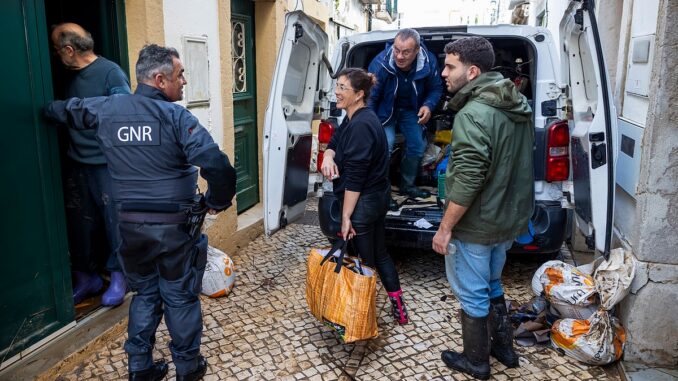
Since last week, the Republican National Guard (GNR) has reinforced its device, mainly in the districts of Leiria, Coimbra, Santarém and Setúbal, focusing on “proximity actions, locating, identifying and checking the well-being of households in situations of greater vulnerability, including elderly people living in isolation“.
In response to the question posed by DN, an official source from this security force said that the military “constituted one of the only points of contact with elderly citizens who found themselves without electricity supply, without communications and in a situation of complete isolationensuring the transmission of essential information, the assessment of its security conditions and the activation of appropriate support mechanisms.
The elements of Republican National Guard They have also been responsible for protecting critical infrastructures: “GNR has maintained the physical security, continuous and discontinuous, of the SIRESP system generators installed in affected areas, ensuring that any failures in the supply of electrical energy do not compromise the radio network used by the relief forces.”
In relation to the number of soldiers on the ground, the Guard guarantees that in addition to the 3000 members of the permanent police force in the most affected regions, “between 120 and 160 soldiers from other Units were deployed daily, from different operational areas”.
This availability includes elements of the Emergency Protection and Relief Unit, Public Order, Traffic, Horse Patrols and Criminal Investigation.
In the responses sent to DN, the Guard explains, for example, that the Emergency Protection and Relief Unit “played an essential role in the immediate response to the catastrophe, particularly in the direct support to populations, including the reconstruction and temporary repair of damaged roofs, carrying out relief actions for people isolated by floods and floodsthe removal of obstacles and debris from communication routes, as well as active collaboration with ANEPC and fire departments”.
Already the horse patrol has been carried out “mainly in rural areas, riverside areas, forest areas and places difficult to access by vehiclesreinforcing proximity and visibility policing. And in direct contact with the population.”
There are also elements of the criminal investigation on the ground that, according to the GNR, are directed “towards the prevention and repression of criminal offenses associated with this type of contexts, namely theft of generators, fuel, cables, water pumps and other critical equipment used to ensure the supply of electricity, water and sanitation”.
The Coastal and Border Control Unit is also on guard with “aquatic environments at strategic points”. There are “250 military personnel, 35 vessels and three unmanned aerial means” to act in flood or flood scenarios. The GNR also has 100 soldiers as reserves at a logistical support base.
Leave a Reply