
Portugal’s public budget balance, as far as it is important to show Brussels (European Commission), international markets and the Republic’s creditors, was supposed to be 0.3% of Gross Domestic Product (GDP) in 2025, but, everything indicates, it will be much higher: it could reach 1% of GDP, if confirmed, the second largest surplus in modern Portugal.
According to analyst accounts from DN, all based on the latest known data (budget execution and economic growth prospects last year (which are not bad at all), the surplus in national accounts could have reached three billion euros at the end of 2025, well above the 948 million euros that the Minister of Finance, Joaquim Miranda Sarmento, estimated last October, when he delivered the State Budget for 2026 (OE 2026).
The government official has always refused to take breaks because all the margin there is in public finances is to reduce (pay) public debt, for example.
In an interview with Público/Rádio RenascençaThis Thursday, the minister said that the Government wants to create a fund for catastrophes and earthquakes, but that from a budgetary point of view the direction will not change: the goal continues to be to reach a new surplus this year (0.1%).
“We will do everything — assuming that there are no new storms and calamities, and that there is not, this year, an international recession that would slow down the Portuguese economy — to maintain the balance of public accounts”, defended the government official to both media outlets.
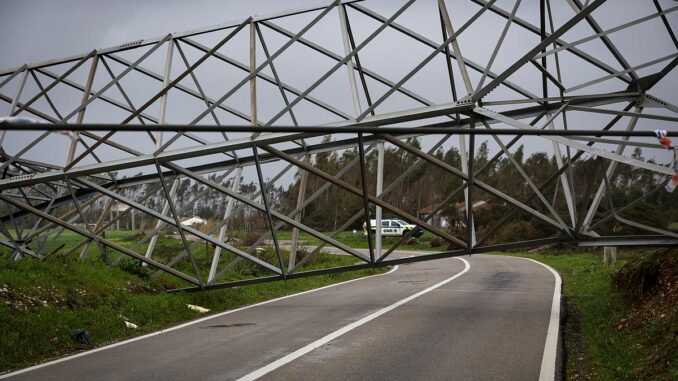
The year 2026 began with extreme adversity. The storms and tempests that devastated homes and businesses, especially in the center of the country. and which continue to ravage the territory, came to demand support from the State.
Last Sunday, four days after the first hit of the storm, the government put forward a package of response measures to respond to losses that it estimated, in a very preliminary way, at 2.5 billion euros, including direct support for the reconstruction of houses and buildings, support for the layoff of workers (as in the pandemic, when the government subsidized companies so that they could keep their employees even when they were at a standstill), grace periods to pay taxes on time (they will have to be paid later), moratoriums to pay bank installments, state guarantees to access credit cheaper and more quickly, etc.
This Thursday, Manuel Castro Almeida, the Minister of Economy, reviewed the balance of destruction at a sharp increase. “In a preliminary estimate, everything indicates that it will exceed four billion euros”, he said in an interview with RTP.
Comfortable starting point
The starting context for public accounts is, however, quite favorable at this moment in time.
The surplus of 0.3% of GDP in 2025 could ultimately be much higher, in national accounts.
In public accounting, ditto. Last week, on Friday, two days after Storm Kristin hit the Central region of the country, the budget execution carried out by Finance showed that the OE 2025 target pointed to a deficit of 1.7 billion euros, but that, at the end of 2025, the government managed to deliver a surplus of 1.3 billion.
If it’s not a break, it’s another big budgetary “success”, giving an annual margin that amounts to three billion euros.
“The data in public accounting corroborate the expectation that we were drawing for a positive surprise in 2025 in national accounting”, says the economist from the BPI research office (BPI Research).
For Vânia Duarte, “in fact, the execution in public accounting allows us to draw some conclusions about how the budget balance in national accounting (official values) will have turned out”, despite the “uncertainty that this transition [contabilística] entails.”
To arrive at the “official” budget balance, in national accounting, which counts for Brussels and international investors, the final work and the seal of the National Statistics Institute (INE) are required.
It is crucial to determine the GDP value and the adjustments to the values reported by Finance in public accounting.
The BPI economist states, in a first approach to the problem, that “if we use the difference between national accounting and public accounting estimated in OE 2026, we would conclude that the budget balance from an official perspective (national accounting) would have been around 1% of GDP, that is, 0.7 percentage points (pp) above the Government’s estimate”.
As mentioned, so far, the best estimate for the 2025 surplus points to 0.3% of GDP, according to minister Miranda Sarmento.
However, the government official has already said (it was in Parliament in January) that he feels “hope” that the surplus in 2025 will be “higher” than expected, the 0.3%.
According to the same economist from BPI Research, “the transition from public to national accounting is impacted by several factors, such as, for example, the accounting for capital injections and loans or the accounting for European funds”.
Therefore, to have a “final reading of the 2025 public accounts”, we must wait for March 26, the day on which INE releases the numbers from the perspective of national accounting, which will be transmitted to Eurostat and the European Union leadership.
Look good
The country is in a state of calamity, but public accounts are in one of the best phases ever.
For the successive governments of the last two decades, the logic and policy to follow are those of “responsibility”, “correct accounts”, “respect for European rules”, etc.
It was like this with the former Finance Ministers, Mário Centeno, João Leão, Fernando Medina (all from the PS).
Miranda Sarmento, from the PSD, has already shown that she does not intend to be an exception. “There is no slack” and, the government official insists, the margin that exists is to reduce the weight of public debt which, although decreasing, remains at a prohibitive 90% of GDP. The European Pact requires a maximum of 60%. Still missing.
Therefore, you have to look good.
This week, Standard & Poor’s (S&P), the largest agency that evaluates and determines the interest rate on Portuguese credit, reaffirmed that it continues to believe in this government and the country.
Adrienne Benassy, the S&P analyst who follows Portugal, says that the stable outlook on the A+ rating (it’s good and safe, for now) “reflects Portugal’s economic resilience amid growing global uncertainty and our expectation that fiscal policies continue to be prudent, despite domestic political instability”.
However, messages. “We can move up the ranking [rating] of Portugal if public debt in relation to GDP decreases significantly or if the economy’s short-term external debt decreases further”.
On the contrary, the rating agency considers “lowering the rating if we observe a change in stance in relation to the aforementioned prudent budgetary policies, if they reverse the fall in public debt, or if the impact of uncertainty in international trade pushes Portugal’s current account surplus towards a deficit”, warns the Republic’s evaluator.
The calamity
S&P was discussing the pros and cons of risk and interest rates in Portugal when the country was hit by a storm of rare proportions.
As DN/DV wrote, the main institutions that make forecasts for the Portuguese economy pointed to growth of 2.2% or 2.3% this year, but this was before Storm Kristin, which mainly devastated the Central area of the country, where many industrial and export activities are concentrated. It was in the early hours of January 28th.
According to very preliminary and conservative calculations, using the first and only official estimate, so far, of the cost of the damage inflicted on populations (families, companies, basic infrastructure), of at least 2.5 billion euros (says the government, this is the value of the first package of measures announced last Sunday, February 1st), means that the 2.3% growth in real terms predicted for 2026, which would result from an increase in the Gross Domestic Product (GDP) in the order of 5.7 billion euros for the year as a whole, is seriously compromised and could end up being much lower, falling to 3.2 billion euros.
And so it is if the expected impact is only that calculated by the government and all attributed to the current year’s activity. This causes the expected annual growth rate for the economy to drop by almost half of a drop, to around 1.3%.
However, neither the negative effect should be confined to just one year, nor will the value remain at just the 2.5 billion euros estimated on Sunday, when it was just four days after Storm Kristin, considering the reports that continue to arrive from the ground, from families and companies. As mentioned, the Minister of Economy has already raised the damage forecast to almost double, four billion euros.
At first, Luís Montenegro, the prime minister, admitted that the destruction he saw and the reports that reached him indicate that the damage is “much greater than expected”.
Last Tuesday, on a visit to Pombal, one of the most attacked regions, the PM reported the “damage caused to homes, businesses and agricultural holdings, many of which still do not have electricity”. And he reaffirmed that the recovery of the Central and West region will take “years”.
According to the government, the 2.5 billion package “includes support for reconstruction, tax and loan payment moratoriums, lines of credit for companies, as well as support for local authorities and the recovery of public infrastructure”.
The devastation of economic activity occurs mainly in the center of the country, a densely industrialized region. Hundreds of factories destroyed or forced to stop, thousands of homes and establishments without electricity, lack of communications, flooded roads, isolated populations, all of this froze the normal course of the economy. Much of the strike continues today, Thursday, February 5th.
Exports, the chosen engine of the Portuguese economy, were also in doubt, of course.
Leave a Reply