
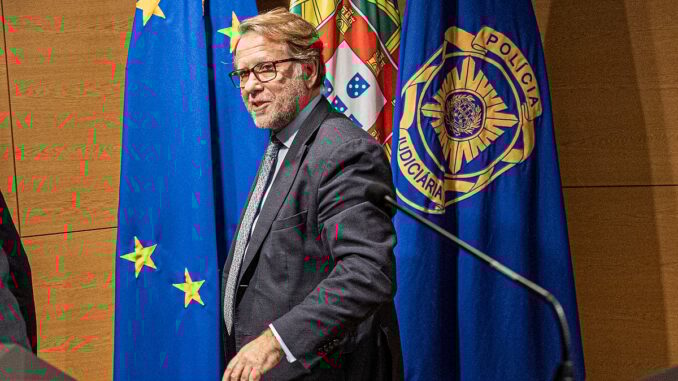
The pedagogy of courage
The idea of courage permeated a large part of Luís Neves’ intervention. Not as thoughtless boldness, but as a requirement for leadership in contexts of uncertainty.
“Not exactly in physical courage, but in the question of necessity and proportionality”, he pointed out. Above all, “in moral and also cognitive courage to lead and act, regardless of the quality, origin or personal conditions of the interlocutors and those targeted. In the courage to act with confidence and determination in clarifying the truth. In leadership and expression, through audacity and creativity, innovation, treating everyone equally.”
“Never be afraid to move forward. Failure is guaranteed [se não avançarmos]. If we don’t dare to do it, we will certainly not be able to achieve our objectives”, he stated.
And he insisted: “Never be afraid of failing. If we don’t dare to do it, we fail at birth. If we don’t dare to write, we die at birth. If we don’t dare to do things outside the box, we die at birth.”
The appeal was to more proactive managers, capable of anticipating criminal phenomena, occupying their intervention space and encouraging teams to move away from merely reactive logic.
Justice secret: internal warning and extended criticism
A more sensitive moment in the speech came when he addressed the confidentiality of the investigation, professional secrecy and judicial secrecy — topics to which he directly associated the credibility of the institution.
After defending “extreme” protection of judicial secrecy, he acknowledged that this could also happen in the PJ itself. “We have people who violate judicial secrecy.”
Also leaving an implicit “message” to the media, he stated: “It’s always the same people delivering the news. When the operations are in Lisbon, it’s always the same person or people anticipating it. These same people, when the operations are in the North of the country or in other regions of the country, never get there.”
From there he drew a more comprehensive conclusion about the system: “So it means it’s not just us. Everyone violates, all actors violate.”
Luís Neves lamented that these practices have been going on “for years” and considered that they compromise the unity of criminal investigation and public trust in justice, arguing that it is necessary to stop what he classified as an “ugly way” of functioning.
Loyalty and mission
Luís Neves highlighted the centrality of the relationship with the Public Prosecutor’s Office (MP), remembering that the work of the PJ is “practically exclusive of support and support” to the holder of the criminal action.
“When we say that here there is a guardianship, the criminal investigation and the only guardianship is the MP, it is no one else. And it is in this umbilical relationship that we have that it is possible to preserve and implement the evidence in respect and collaboration with all institutional partners, namely, with the Armed Forces, with the Security Forces, always striving for loyalty, mutual assistance, complementarity in the public interest relationship, always the public interest”, he asserted.
This loyalty, he added, “must be cultivated daily”, in a relationship that he described as structuring for criminal investigation.
He also drew attention to the importance of complying with the Criminal Organization and Investigation Law (LOIC). “The LOIC is a law that must be respected by everyone. We include ourselves, others and even the MP. Everyone has to comply with the LOIC. The LOIC does not allow Monday and Tuesday and Thursday and Friday to be violated. Because this calls into question the uniqueness of the criminal investigation.”
The ultimate purpose of investigative work, he summarized, is clear: “We all want to reach the end of an investigation and know whether there was a crime or not. And if there is a crime, above all, we have to find the suspects. And proof cannot be bought.”
Human rights and priorities
In the final part, the national director reaffirmed principles such as legality, impartiality, transparency and ethics, highlighting respect for human rights as an insurmountable limit of police action.
He also listed priority areas of activity for the PJ, such as terrorism and violent extremism, cybercrime, economic and financial crime, crimes against children and young people, trafficking in people, weapons and drugs, crime against the social state and environmental crimes.
In short, he left the new leaders with a double requirement: to lead by example and protect the integrity of the investigation. The legitimacy of the PJ, he suggested, depends both on its effectiveness in fighting crime and on the way it conducts this fight.
The new leaders
1- Pedro Miguel Ventura Pratas da Fonseca, as Deputy National Director
2- Perpétua Justina Costa Crispim, as Director of the National Anti-Corruption Unit
3- João Miguel Neto Garcia, as Director of the Southern Board
4- António Alcides Gomes Trogano, as Deputy Director of the Northern Directorate
5- Camilo Augusto Rodrigues Queiroz de Oliveira, as Deputy Director of the Center’s Board of Directors
6- Pedro Manuel Marques Maia, as Director of the Setúbal Criminal Investigation Department
7- Rui Manuel Viegas Pires de Oliveira Nunes, as Director of the Criminal Investigation Department of Aveiro
8- Renato Carlos de Medeiros Furtado, as Director of the Criminal Investigation Department of the Azores
9- António José Simões Morais, as Director of the International Cooperation Unit
10- Afonso Manuel de Jesus Sales, as Director of the Asset Recovery Office
Leave a Reply