
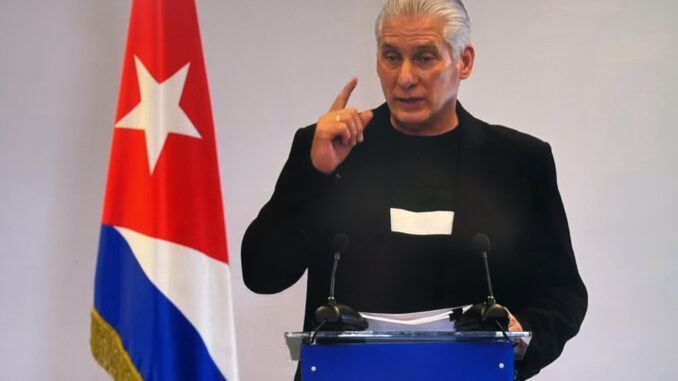
HAVANA, Cuba.- This Thursday, the president of cuba, Miguel Diaz-Canelassured that the island “is willing to dialogue with the United States” on “any topic,” to build “a civilized relationship between neighbors” and “mutual benefit.”
In one unusual televised appearancethe president pointed out that the island is in a position to speak with Washington from a “position of respect” for the “sovereignty” and “self-determination” of the Caribbean country without “addressing issues” that, for the Executive in Havana, can be “understood as interference.”
“From a dialogue like that you can build a civilized neighbor relationship“said the Cuban president.
Cuban President Miguel Díaz-Canel sent a “dialogue” message against Trump’s threats to toughen economic restrictions. He stated that they are ready to sit at the table despite the sanctions that target Havana’s oil and financial resources. pic.twitter.com/JdXFrGb86e
— milena (new account) (@MilenaEmmastrt) February 5, 2026
Among the issues that the Cuban Government would be willing to address with the United States are “immigration issues, security, the fight against drug trafficking, the fight against terrorism, environmental (…) scientific collaboration,” among others.
It is not the first time that Díaz-Canel, in the midst of the escalation of tensions with the North American country after the capture of the Venezuelan president, Nicolas Maduroand the oil blockade of the island, points out that the island is open to dialogue.
On January 12, in a publication in
He also denied that Havana has talks with the United States, after President Trump urged the Caribbean country to “reach an agreement before it is too late.”

The vice minister of Foreign Relations of Cuba, Carlos Fernández de Cossíohad denied on Tuesday, in an interview with EFE, that Havana is jointly designing a negotiating table with the US.
His statements contrast with those made in recent days by Trump, who has assured on several occasions that his Administration is having a negotiation with the Cuban Government, even at a high level.
Cuba recognizes that it has paralyzed part of its energy production

In his speech, the president of Cuba, Miguel Díaz-Canel, recognized that the country has paralyzed all its energy production with diesel and fuel oil engines due to pressure from the US and its oil blockade.
In his televised appearance, Díaz-Canel explained that lately the country has not been able to count on any of its distributed generation parks (engines), with a total installed power of around 1,300 megawatts (MW).
These systems are key to the National Electric System (SEN) and which in recent years accounted for around 40% of the country’s energy mix.
Cuba suffers a serious energy crisis

Cuba suffers a serious energy crisis since mid-2024 due to the frequent breakdowns of its obsolete thermoelectric plants and the lack of foreign currency to import the fuels necessary to fuel distributed generation.
US military operation in Venezuela
The US military operation in Caracas meant for Havana, in addition to the blow to a key regional ally, the end of vital energy supplies for the island.
Different experts estimate that of the 110,000 barrels of oil per day that Cuba needs to satisfy its energy needs, Venezuela contributed about 30,000 in 2025.
Trump god another twist more to the pressure on Cuba by signing on January 29 a presidential order that threatened to trade tariffs to all countries that supplied oil to the island.
The Cuban expert Jorge Piñonspecialist of University of Texas Energy Institute (USA) estimated that, if it did not receive new oil shipments, Cuba would be in a “serious crisis” by March.
So far this year, Cuba has only received one oil tanker, from Mexico, with about 86,000 barrels of crude oil.
You might also be interested in: “Colombian businessman Alex Saab is captured in Venezuela”
Leave a Reply