
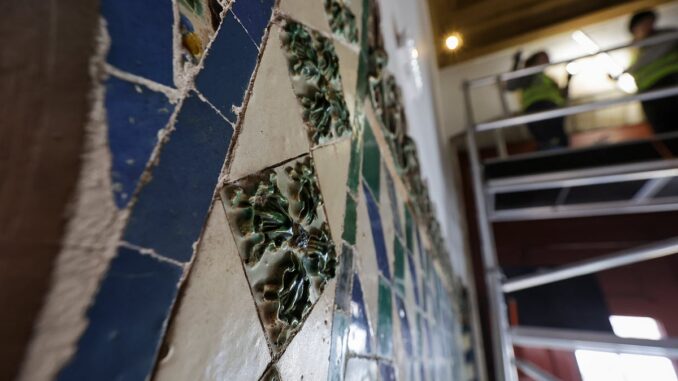
The work has involved national and international experts, in what is considered an intervention that also looks to the future, explains the executive director of the World Monument Fund in Portugal.
“The Palace, its diversity and the quality of the specimens it has allowed this project, which is a kind of pilot project, in which we are going to test solutions, approaches, we are involving scientists who are experts in tiled heritage. We accepted this challenge because the tile is a living heritage“, says Teresa Veiga de Macedo.
In May last year, researchers involved in the project carried out a first workshop to analyze the work. “The idea is to involve this community in discussing the best solutions throughout the process. This will be very enriching and will give a lot of security about what is the best way to treat this heritage”, adds Teresa Veiga de Macedo, highlighting that “Internationally, Portugal is looked at, in fact, as a place where knowledge is gathered”. With this project, the specialist believes that the country gains “the conditions to offer, in international terms, this opportunity to advance in this area”.
Scheduled for completion in July 2026, this first phase will involve the Arab Room and the Chamber of D. Afonso VI and was awarded for the sum of 147 thousand euros. The second phase will restore the tiles of the Gruta dos Banhos, also estimated to last six months and scheduled for completion in January 2027, with an estimated cost of around 90 thousand euros.
The resources are provided in equal parts by Parques de Sintra and the World Monuments Fund in Portugal, with the philanthropic support of the foundations The Robert W. Wilson Charitable Trust, Tianaderrah Foundation / Nellie and Robert Gipson and Fundação Millennium BCP.
Leave a Reply