
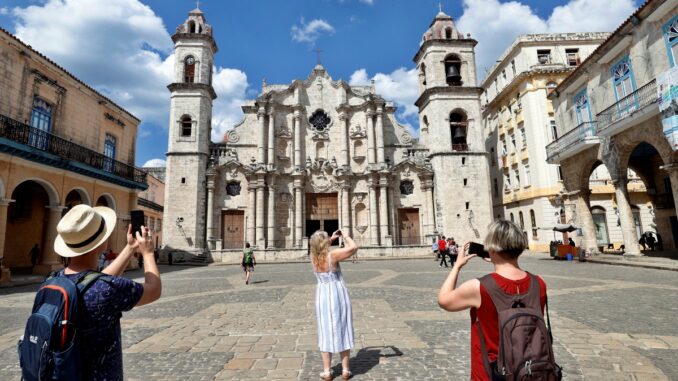
HAVANA (EFE).— Cuba’s tourism sector closed 2025 with its worst record of international travelers since 2002, receiving just 1.8 million visitors, without considering the years marked by the Covid-19 pandemic, according to official figures.
The data, although anticipated by previous indicators, confirmed the deep crisis that one of the country’s main sources of foreign currency is going through. During the first half of the year, the hotel occupancy rate fell seven percentage points compared to 2024, reaching 21.5%. The contraction consolidates a negative trend sustained over the last seven years, in contrast to the boom that the sector experienced in 2018, when Cuba reached its historical record of 4.7 million international tourists.
This maximum coincided with the period of the so-called diplomatic “thaw” with the United States, promoted during the administration of President Barack Obama, which facilitated travel, air connections and expectations of expansion.
The panorama changed with the arrival of Donald Trump to the White House, whose first term reestablished sanctions and restrictions, to which were later added the internal economic and energy crisis, the deterioration of services and the cutting of international air routes.
The magnitude of the decline was reflected in December, a month traditionally of high demand, when only 180,944 international travelers arrived, the worst monthly record since at least 2022, even in a pandemic context.
Canada remained the main issuing market with 754,010 visitors, followed by Russia with 131,882, although both countries registered year-on-year drops of 12.4% and 29%, respectively, according to the National Office of Statistics and Information (ONEI). They were followed by the United States, Mexico, Argentina, Spain and France, all with double-digit declines, except Argentina, which grew 13.6%, and Colombia, with an 8% increase in the flow of travelers.
Reduce your visits
The Cuban community abroad also reduced its visits to the island, with a drop of 22.6%, a behavior that reflects the combined impact of the economic crisis, limited services and the perception of health insecurity.
Despite the adverse results, the Cuban Government maintained its commitment to tourism as an engine of economic recovery, due to its weight in the gross domestic product and the generation of foreign currency, along with remittances and professional services.
This strategy translated into strong state investment in luxury hotels. In 2024 alone, the sector concentrated almost 40% of total public investment, eleven times more than that allocated jointly to Health and Education, which generated criticism from experts and opponents.
For the Cuban economist José Luis Perelló, the official policy does not constitute “a tourism development plan”, but rather “a hotel investment plan” of a real estate nature, while the Executive also announced the rental of hotels to international chains, a relevant change in a sector traditionally controlled by the State and the military consortium GAESA.
Cuba Tourism sector, in crisis
Cuban tourism closed 2025 with historically low figures and multiple factors against it.
Historic fall
The number of international visitors fell to levels not seen in more than two decades, affected by sanctions, economic crisis, deterioration of services and reduction of air routes, which weakened the recovery after the pandemic.
State investment
The Cuban government prioritized the construction of luxury hotels as an economic strategy, concentrating a large part of public investment, despite low occupancy and criticism for relegating key social areas such as health and education.
Deteriorated image
Health alerts for dengue and chikungunya, along with travel warnings due to a shortage of basic services, affected the international perception of Cuba as a reliable tourist destination during 2025.
Leave a Reply