
Hoy inaugurates Multiplicado El Prado. Photos as shared memoryexhibition that contains 44 curious pieces of photography and above all draws attention to what often goes unnoticed: that the museum preserves not only images but also keep the instructions in which these images were viewed, copied, distributed and recorded.
It is the first monographic exhibition dedicated to and created by photography with own funds. The museum highlights a collection of more than 10,000 photographs of great patrimonial importance.
The exhibition, located in room 60, was commissioned by Beatriz Sánchez Torija of the Illustrations, Prints and Photographs Collection Department and its author Visitor mapsstereoscopic cards, album, carbon, gelatin, photomechanical and postal copies.
Standard formats that were built in the second half of the 19th century and the first decades of the 20th. portable, domestic, collectible Prado. Images that are suitable for collection and storage for visitor, for student, for expert and for cultural trade.
The process of photographing the works of the museum began on in a systematic way in the 1860s. The technical limitations of the first procedures force in many cases to move the pieces outside to ensure natural light.
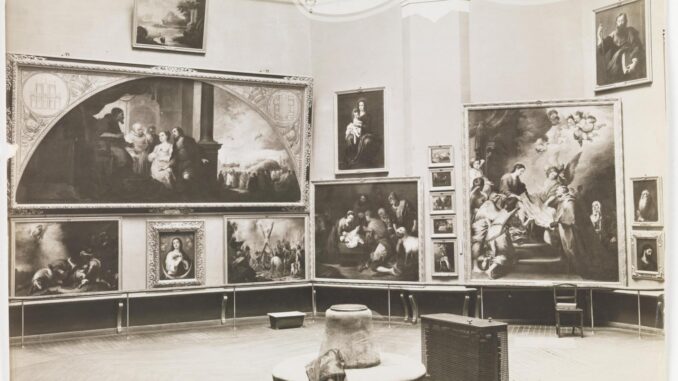
A view of Queen Isabella’s room from a contemporary perspective. Photo: Museo Nacional del Prado.
Once you get the negatives, the photographers will make the positives in them various standardized formats that can be soldwhich promoted the wide circulation of Prado paintings both among the general public and among experts and collectors.
Like their importance postcardswhich serve to redistribute pieces of the museum, like exchanging letters between family members or lovers. At the beginning of the twentieth century, the generalization of postal items provided a new impetus for the dissemination of collections.
Thanks to printing techniques such as phototyping, these images became popular and enabled Prado to acquire a truly international dimensionfixing photography as a bridge between museum and society.
We can also use photos for some purpose I find that it helps us to understand what the museology of the past was likehow the walls were covered with works, the way they were written on the cards or the small number of visitors who marveled at the rooms and what surprises us when we compare it with how the rooms come today.
Here are reproductions of works from the museum created by the photographer-editor Juan Laurent y Jose Lacoste (junto a Juana Roig), además de Jane Clifford, Braun, Clement & Cie., Hauser and Menetamong others.
Leave a Reply