
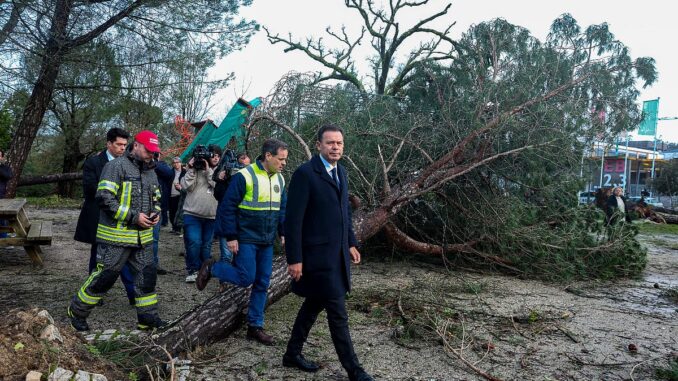
Portugal is facing the severe consequences of Storm Kristin, which left hundreds of thousands of people without electricity, damaged essential infrastructure and is requiring a prolonged emergency effort in several parts of the country.
Despite the scale of the impacts and the duration of the response, so far no formal request has been made to Brussels to activate the European Civil Protection Mechanism, the European Union’s instrument aimed at strengthening responses to disasters that exceed national capacity.
O President of the National Emergency and Civil Protection Authority, José Manuel Mouraargued that “it is not justified at all” to resort to the mechanism because, in his assessment, the country has not yet exhausted its national response capacity.
The Government has emphasized that the decision depends on technical criteria and the assessment of those on the ground. The Minister of Foreign Affairs, Paulo Rangelsaid that activation “depends on technical rules and technical assessment by Civil Protection” and that the Government will not override the technical judgment of the authorities in relation to the European request, calling for respect for that judgment and criticizing political opportunism.
On the opposition side, however, different positions emerged. The general secretary of the PS, José Luís Carneiroargued that activation should be considered as a way of reinforcing resources and relieving pressure on structures that are already in high demand. For these sectors, the issue is not just technical, but also one of strategic prudence and the mobilization of all available instruments in a large-scale crisis.
It is in this context that it is important to better understand what the European Civil Protection Mechanism is, how it works and what advantages and limitations it presents. Will activating this Mechanism be a sign of the State’s weakness or of intelligence and realism?
What is the European Civil Protection Mechanism?
Created in 2001, the European Civil Protection Mechanism is the European Union’s cooperation system to respond to natural or man-made disasters that exceed the capacity of a Member State.
It starts from a simple principle: no country can be prepared for all extreme scenarios, but several countries together can respond better to large-scale crises.
The mechanism does not replace the national response. It works as reinforcement when the internal media are under strong pressure.
How does it work in practice?
The mechanism is activated at the request of the affected country. This request is addressed to the European Commission’s Emergency Response Coordination Center (ERCC), which operates 24 hours a day and serves as a central coordination platform.
Otc:
1- Evaluates needs communicated by the affected country
2- Disseminates requests for help across participating States
3- Coordinates assistance offers
4- Organizes the logistical response
What kind of aid can be mobilized?
Among the means usually available are:
1- Search and rescue teams
2- Fire fighting modules
3- Large capacity pumps for floods
4- Water purification systems
5- Field hospitals
6- Experts in damage assessment
7- Emergency coordination teams
The mechanism can also co-finance transport costs for the means sent.
When does it make sense to activate?
The mechanism is designed for situations in which:
– National media are overloaded
– The geographic dimension of the damage is very broad
– The response lasts over time
– There is a risk of the situation worsening
– Local teams are experiencing operational and human exhaustion
It is not an instrument of first reaction — this is always national. It is a reinforcement in scenarios of accumulated pressure.
Advantages of activating
– Reinforcement of capacity in the field
More teams and equipment make it possible to relieve exhausted national structures and accelerate interventions.
– Sharing of responsibility
The answer no longer lies solely with national or local authorities.
– Structured coordination
ERCC organizes aid flows and avoids duplication.
– Knowledge sharing
Teams from countries with similar experiences bring already tested solutions.
– Visible solidarity
The European presence on the ground has symbolic value and reinforces people’s confidence.
The psychological factor
This one is often underestimated. Prolonged crises generate extreme wear and tear on local leaders and populations. The arrival of external help reduces the feeling of isolation and distributes the weight of the decision. Asking for help is no longer seen as incapacity and becomes a normal institutional procedure in large-scale crises.
A mayor with local teams exhausted, roads closed and communication systems affected, the arrival of a coordinated European team is an injection of immediate operational capacity. It’s no longer just your responsibility; it becomes a shared mission that also provides psychological comfort of fundamental importance.
Loneliness during a disaster is a huge psychological burden and some say it is not important. But the arrival of additional capabilities always provides more than material help and encouragement for leaders, mayors and, above all, for the population. The arrival of visible and concrete aid from other European countries is a powerful signal to the affected populations. Combat the feeling of isolation and abandonment.
Seeing the EU flag alongside the national flag in relief operations can create a narrative of collective solidarity. It gives hope that recovery is possible, because the strength of many is being put at the service of one. Ultimately, for the mayor, asking for help can seem like an admission of incapacity. And in this sense, activating the EU mechanism collectivizes and legitimizes this individual request from the various mayors. It is an institutional process, not an individual failure. The mayor can say to his citizens: “We managed to bring the strength of 27 countries here”, which reinforces his authority and eases his psychological burden.
Limitations and challenges
– Does not replace the national response
It’s always a complement.
– Mobilization time
There is a delay between request and arrival of media.
– Need for effective integration
External teams require coordination to avoid overlapping missions.
– Political sensitivity
Some decision-makers fear that the request will be interpreted as a sign of fragility.
Conclusion
The European mechanism was created to act as a backup in exceptional situations. Its use varies depending on the nature of the crisis, the installed capacity of each country and the assessment made by national authorities. In the case of Storm Kristin and Until Ver, from Leonardo, Portugal chose to manage the response with its own resources and other European instruments.
European experience shows that the mechanism is used selectively, depending on the scale of the damage and the predictable duration of the response. Its activation is always a sovereign decision of the affected State. More than a symbolic choice, it is an operational tool whose relevance depends on the concrete evolution of each situation.
Leave a Reply