
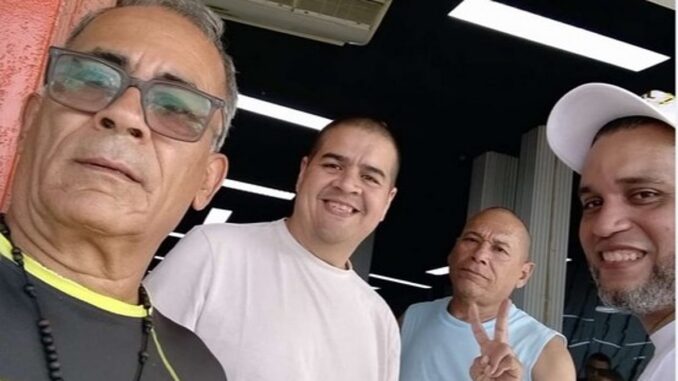
Portuguese-Venezuelan doctor Pedro Fernández, detained in Venezuela for opposition activity on social media, was released this Sunday, February 1, confirmed the Portuguese Ministry of Foreign Affairs (MNE).
“The Government welcomes the release of the Portuguese-Venezuelan citizen Pedro Fernández, detained since last October. To himself and his family, the solidarity of the Portuguese”, wrote the MNE on the social network X.
According to Jornal da Madeira, the doctor of Portuguese descent is the son of a Madeiran father originally from Ribeira Brava, and the announcement of his release was made this afternoon by Carlos Fernandes, a social-democratic deputy of the Regional Assembly who “has been following the crisis in Venezuela very closely since the beginning of the year”.
“Portugal will continue to make every political and diplomatic effort to release citizens detained in Venezuela”, assured the MNE on the social network X.
The Portuguese and Portuguese-descendant community in Venezuela, mostly from Madeira, is estimated at half a million people.
The Venezuelan interim president, Delcy Rodríguez, announced on January 30 a general amnesty law in the country, to free political prisoners detained since 1999 until now, a period that covers the Chavista governments.
The announcement comes less than a month after the capture, on January 3, of President Nicolás Maduro in a “large-scale” military operation carried out in the South American country by the United States, which intends to put him on trial.
Maduro is accused by the US courts of four federal crimes: conspiracy to commit narco-terrorism, conspiracy to import cocaine, possession of machine guns and destructive devices and conspiracy to possess such weapons in support of criminal activities, in addition to collaboration with organizations classified as terrorist by Washington.
Sworn in on January 5 by decision of the Supreme Court and with the support of the Venezuelan Armed Forces, Delcy Rodríguez also proposed on Friday that Helicoide, headquarters of the Bolivarian National Secret Service in Caracas, denounced by non-governmental organizations (NGOs) and members of the opposition as a torture center, be transformed into a social and sports center.
In Venezuela, there are at least 711 political prisoners, including 65 foreigners, according to the NGO Foro Penal, specialized in the defense of political prisoners.
Under pressure from the United States, following the arrest of Nicolás Maduro, the Venezuelan Government promised on January 8 to release political prisoners, but such releases have only occurred sporadically.
The Venezuelan Government announced on January 26 that more than 800 political prisoners had been released, without ever referring to them as such, claiming that the releases began “before December”, although Maduro’s capture took place on January 3rd.
The NGO Foro Penal disputes this number, reporting only 418 releases since December, 303 of which have occurred since January 8th.
Dozens of family members have been camped in front of prisons across the country since January 8, awaiting their release.
Several NGOs have clarified that political prisoners have been released, but not completely, as they have received alternative measures to prison.
The coordinator of the organization Justice, Encounter and Forgiveness (JEP), Martha Tineo, indicated on January 28 that political prisoners who have been released from prison in recent weeks face restrictions such as the ban on leaving the country and speaking to the press about their cases and the obligation to periodically appear before the courts.
Leave a Reply