
Por Héctor López Terán*/Latinoamérica21
Since the twentieth century, mining has become a larger economic activity in Latin America. It was transformed into a device of territorial, ecological and political reorganization. Under the discussion of development and modernizationThe expansion of the mining front has changed the foundations that support life and sovereignty in the region.
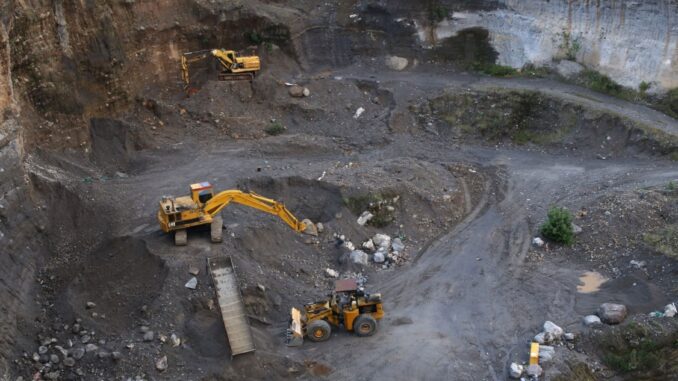
The first impact on nature. Large-scale mining – mostly in the open – does not just change ecosystems: expendable los vuelves. Contaminated rivers, fragmented forests and gaping mountains are the visible expression of a deeper process: the transformation of living territories into spaces of intensive mining. But the damage is not limited to the ecological plan. Ecological devastation is accompanied by the dispossession of communities whose relationship to nature is neither utilitarian nor commercial, but is a constitutive part of its form of life.
The second thing about this open inheritance is the production specialization required in Latin American countries. Although mining has colonial origins, its recent consolidation responds to its own dynamics contemporary financial capitalism: cycles of price increases, technological changes, transformations in the organization of production and energy, and financial dominance. In other words, to a mixed metabolism of capital. Latin America did not choose this place in the global economy: it was integrated as a strategic source of mineral resources to support the global accumulation of central and emerging economies.
This process was not random and was not the result of a decision by the authorities. It forms part of the structural functioning of dependent capitalism. Since the twentieth century, nature has been “flexible” to transform itself not only into a source of productive but also financial resources. After the battle of the big mining corporations, behind the call for modernization there was a deep opening: the loss of sovereignty over revenues and the subordination of national interests to the mandate of national private capital, but above all transnational.
While the mining companies show visible jaws, the second circuit of appropriation has been operating in the shadows. Shareholders, inverse funds and global banks extrapolate value without touching territory. The natural reward has become only a physical yield: it has been transformed into a financial promise, traded on exchanges and futures markets, for the lejos of communities affected by extraction. Thus, mining not only generated productive excesses, but also financial annuities transfers to global economic power centers.
Now this dynamic is responding to new forms. The hegemonic dispute between the United States and China is once again putting Latin America at the center of the global table. Call “energy transition” and a new technological cycle characterized by digitization converted to strategic minerals in key areas for industry, national security and technology leadership. The result is not new: the historical mechanisms of despojo are recycled, now legitimized by green and technological language, while the disruption of economic and ecological design deepens.
Faced with this scenario, natural resource management becomes a critical issue. It cannot be thought of only in national or regional circles. Latin America presents a real opportunity for manipulation: without its minerals, much of the life cycle of current technologies is simply unviable. However, this feature will not be activated automatically. It requires coordinated political action, joint regulation and clear limits on the financial power that dominates mining markets today.
A regional strategy would allow you to capture extraordinary rents, limit demand shortages in global circuits and direct excesses to transform production matrices. PUSH mineral diversity there is a strategic wind for the region: each country can bring an example of the value chain and build collective strength in the face of mining capital. Without coordination, this outcome becomes vulnerable; with it you can turn into the ability to negotiate.
However, no alternative will be viable if you ignore those on the front lines of the conflict. Communities, the living expression of a pluralistic and diverse society, face the irreversible consequences of intensive mining, both industrial and artisanal. Recognizing one’s own forms of life and relationship to nature is not a symbolic gesture, but rather a basic condition for the idea of success in mining braking. Without a state that defines the territory as part of one sober politicstransnational capital operates with a freedom – and violence – that guarantees impunity.
What is at stake is not just an economic model. It is the ability to decide the future of the region. Persistence in the primary exporter model means deepening dependence and accelerating ecological devastation. More than minerals, Latin America faces a historical dilemma: to follow being a source of raw materials or to build its own path that prioritizes the life, autonomy and needs of its peoples.
Because in the last case it is not only about extraer recursos. When it comes to making decisions here, the fate of the territory and the people who live there are decided.
*Héctor López Terán is an economist, teacher of Latin American Studies at the Universidad Nacional Autónoma de México (UNAM) and educator of Sociology at the Facultad Latinoamericano de Ciencias Sociales (FLACSO). PhD candidate in Latin American Studies UNAM and investigator of the Núcleo de Pesquisa de Geopolítica, Integração Regional e Sistema Mundial de la Universidad Federal de Río de Janeiro (UFRJ).
Leave a Reply